Glamping helps many people relax because it creates a softer bridge between everyday life and the outdoors. Instead of asking someone to fully rough it, it gives them a calmer way to step away from screens, schedules, noise, and constant responsibilities while still feeling comfortable, safe, and cared for.
For many people, daily stress does not disappear just because they take time off. Their body may leave the office, the house, or the usual routine, but their mind keeps running. They still think about messages, errands, work, family needs, unfinished tasks, and the pressure to stay available.
Glamping can help because it changes the setting without adding too many new difficulties. A peaceful cabin, safari tent, yurt, tiny home, or well-designed outdoor retreat can make it easier to slow down without worrying about every detail of traditional camping.
A gentler way to step outside your normal routine
One reason glamping feels relaxing is that it interrupts the rhythm of daily life. At home, most people are surrounded by reminders of what needs to be done. There are dishes, laundry, emails, bills, appointments, notifications, and small unfinished tasks everywhere.
A glamping setting removes many of those visual and mental cues.
You may still have your phone. You may still have thoughts about normal life. But the environment asks something different from you. It invites you to notice trees, fresh air, quiet mornings, simple meals, soft lighting, and slower transitions between parts of the day.
That change matters because stress often feeds on repetition. When every day looks and feels the same, the mind can stay locked into the same patterns. A different setting gives the nervous system a chance to recognize that it is not in the same demand-heavy environment.
Comfort can make disconnecting feel easier
Some people assume that disconnecting from stress means they need to be uncomfortable. They imagine sleeping on hard ground, cooking with limited supplies, dealing with bugs, or managing unfamiliar outdoor tasks.
For some people, that kind of camping is enjoyable. For others, it creates more stress than relief.
Glamping works well for many people because it reduces the friction. A real bed, a clean bathroom, a cozy shelter, simple heating or cooling, and a prepared space can make the outdoors feel more accessible. Instead of spending most of the trip managing discomfort, the person has more room to actually rest.
This is not about being less adventurous. It is about understanding what helps you relax.
If someone is already mentally tired, emotionally drained, or overstimulated, removing unnecessary stressors can make the experience more restorative. Comfort becomes a support system, not a weakness.
Nature slows the pace without demanding performance
Glamping often works best when it gives people access to nature without turning the trip into another achievement. There does not need to be a packed itinerary, a long hiking plan, or a list of activities to complete.
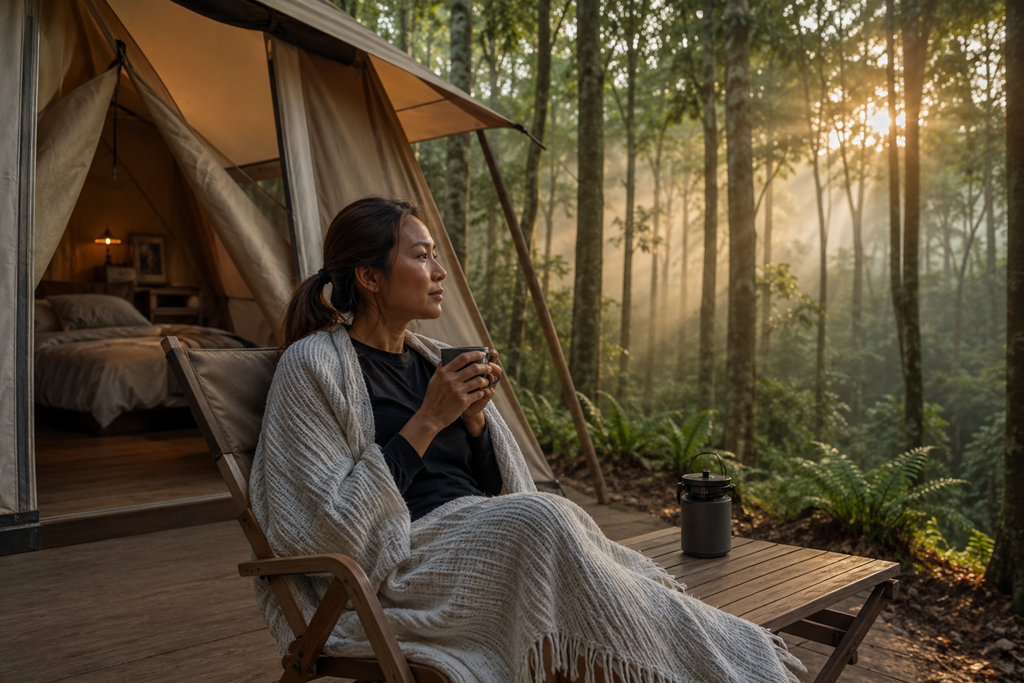
A quiet morning outside with coffee can be enough. Sitting near a fire can be enough. Reading beside a window with trees in view can be enough. Taking a short walk without tracking steps or timing the route can be enough.
That is part of the appeal. Glamping gives people permission to experience nature in a simple, low-pressure way.
In everyday life, many people are used to measuring progress. They measure productivity, fitness, spending, parenting, career movement, home tasks, and personal improvement. Glamping can gently interrupt that mindset. It allows the day to feel valuable even when very little is being accomplished.
The real benefit is often mental distance
The word “disconnect” does not always mean completely turning everything off. For many people, it means creating enough distance from normal pressures to think more clearly and breathe more easily.
Glamping can help create that distance because the setting feels separate from daily life. The sounds are different. The light is different. The pace is different. Even small changes, like eating outside or waking up to natural light, can make the mind feel less crowded.
This distance can help people notice how much tension they have been carrying. It may become clearer that they have been rushing through meals, checking their phone without thinking, sleeping poorly, or treating every quiet moment as something to fill.
A glamping trip does not solve all of that permanently. But it can create a pause long enough for someone to recognize what they need more of when they return home.
Glamping can reduce decision fatigue
Daily stress is not only caused by major problems. It often comes from too many small decisions.
What needs to be handled first? What should be cooked? Who needs a reply? What time should everything happen? What has been forgotten? What should be fixed, bought, cleaned, scheduled, or planned?
A well-chosen glamping stay can reduce some of that mental load. The space is already set up. The sleeping arrangement is clear. The environment is designed for rest. The day may not require much more than eating, walking, sitting, talking, reading, or sleeping.
That simplicity can feel surprisingly powerful.
When fewer decisions are competing for attention, the mind has room to settle. The person may not even realize how tired they were from managing constant choices until those choices become fewer for a short time.
It helps when the trip is not overplanned
One pattern that can make glamping less relaxing is treating it like another project. Some people try to optimize the entire trip. They plan every meal, every photo, every outing, every sunrise, every scenic stop, and every detail of the experience.
That can turn a restful escape into another performance.
Glamping tends to feel more restorative when there is enough structure to feel comfortable, but not so much structure that the trip becomes rigid. A few simple plans can help. Too many plans can recreate the same pressure the person was trying to leave behind.
The most relaxing glamping experiences often include open space in the day. Time to sit. Time to wander. Time to do nothing in particular. Time to let the body catch up with the mind.
Disconnecting does not have to mean disappearing
Another misunderstanding is that a person must fully unplug to benefit from glamping. While a complete digital break can be helpful for some, it is not realistic or comfortable for everyone.
Parents may need to stay reachable. Business owners may need to check in briefly. Some people may feel calmer knowing they can access maps, weather, or emergency information.
The better question is not always, “Can I turn everything off?” It may be, “Can I stop letting everything pull at me all day?”
A softer version of disconnecting might mean keeping the phone nearby but not constantly checking it. It might mean taking photos without scrolling afterward. It might mean setting one small check-in window, then leaving the rest of the day open.
The goal is not perfection. The goal is relief.
The setting supports emotional reset
Glamping can also help because it makes rest feel intentional. At home, relaxing can sometimes feel like something squeezed between obligations. In a glamping setting, rest becomes part of the reason for being there.
The design of the space often reinforces that. A comfortable bed, soft outdoor seating, warm lighting, a fire pit, a deck, a view, or a quiet path can all send the same message: slow down.
That matters emotionally. Many people need an environment that gives them permission to stop performing. They need a place where rest does not feel lazy, where quiet does not feel empty, and where being unavailable for a little while does not feel irresponsible.
Glamping can offer that kind of permission in a practical, approachable way.
It can help people reconnect with simple pleasures
Daily stress often narrows attention. People become focused on what is next, what is wrong, what is late, or what needs to be handled. Over time, simple pleasures can feel distant or unimportant.
Glamping can bring some of those small pleasures back into focus.
Warm coffee outside. Clean sheets after a long day in fresh air. A quiet conversation without the television on. The sound of leaves. A slow breakfast. A book that finally gets opened. A sunset that is not rushed past.
These moments are not complicated, but they can be grounding. They remind people that relaxation does not always need to be elaborate. Sometimes it comes from having fewer interruptions and more space to notice what is already calming.
Why glamping feels different from a normal vacation
A traditional vacation can still involve crowded airports, busy hotels, packed schedules, traffic, reservations, and pressure to make the most of every minute. Those trips can be enjoyable, but they are not always restful.
Glamping often feels different because it usually centers on fewer distractions. The experience is not always about sightseeing or entertainment. It is often about being in one place and letting that place do some of the work.
That slower rhythm can be especially helpful for people who are tired of constant stimulation. Instead of replacing work stress with vacation stress, glamping can create a quieter kind of break.
It does not need to be fancy to work. The most important part is not luxury for its own sake. It is the combination of comfort, nature, simplicity, and distance from normal demands.
The clearest benefit is a calmer return to yourself
Glamping helps many people relax and disconnect because it gives them a realistic way to pause. It does not require them to become expert campers, abandon comfort, or completely transform their lifestyle. It simply creates a more peaceful environment where rest feels easier to accept.
For someone who feels overstimulated, tired, or mentally crowded, that can be enough to make a meaningful difference.
The value of glamping is not only in the beautiful setting. It is in the space it creates between you and the demands that usually shape your day. In that space, it becomes easier to breathe, notice, rest, and remember what it feels like to move at a calmer pace.
Download Our Free E-book!