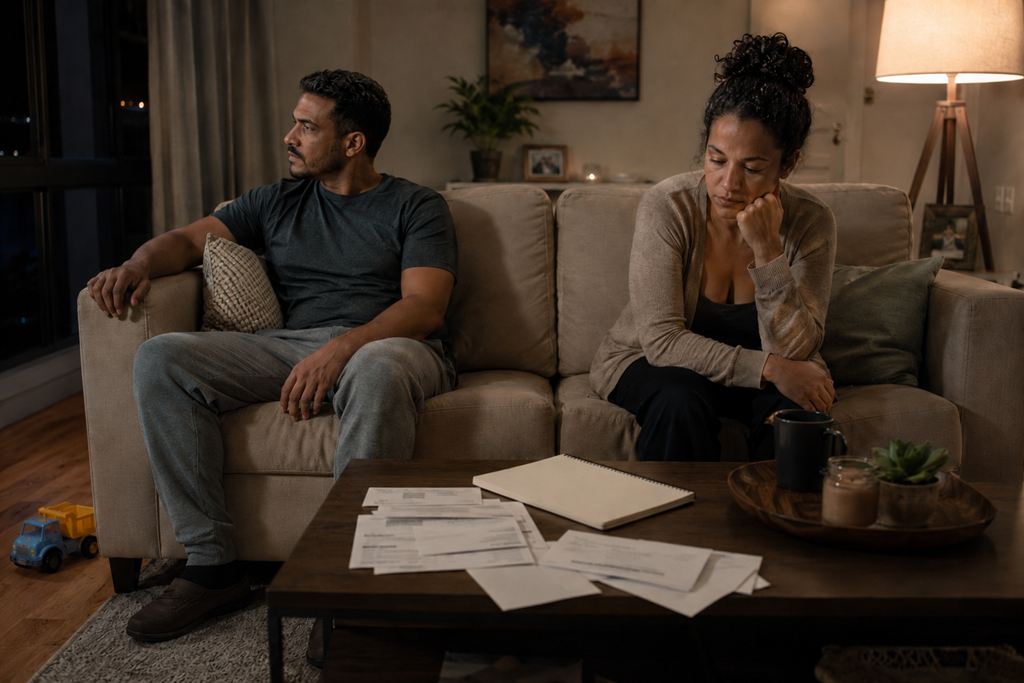
Money anxiety can affect relationships at home by making everyday interactions feel more tense, defensive, or emotionally loaded than they would otherwise. It may show up as short answers, repeated arguments, silence, irritation, blame, avoidance, or feeling like every household decision has a hidden financial weight behind it.
This does not always mean a couple or family has a “relationship problem” at the core. Sometimes the relationship is carrying the pressure of money fears that have not been named clearly.
When someone is worried about bills, debt, rising expenses, unstable income, or not having enough room to breathe financially, that worry often follows them into the kitchen, bedroom, car, family room, and daily conversations. The stress may be about money, but the tension often lands on the people closest to them.
Money Worry Often Changes The Tone Before The Topic Comes Up
One of the hardest parts of money anxiety at home is that it does not always announce itself directly.
A person may not say, “I’m scared we’re falling behind.” Instead, they may become quiet after checking an account balance. They may get irritated when someone mentions ordering food. They may react strongly to a small purchase that would not usually matter. They may seem distant during family time because part of their mind is still calculating what is due next.
This can confuse everyone involved.
The other person may feel judged, controlled, ignored, or criticized without realizing that money fear is sitting underneath the reaction. Children may sense the tension even when no one explains it. A partner may start walking on eggshells because they do not know which small decision might lead to an argument.
The issue is not only the financial pressure itself. It is what unspoken financial pressure does to the emotional atmosphere inside the home.
Small Decisions Can Start Feeling Bigger Than They Are
Money anxiety can make ordinary household choices feel like high-stakes decisions.
A grocery run becomes a source of stress. A child asking for a school activity feels like another financial demand. A partner buying something small may feel careless, even if the amount is not large. A broken appliance, car repair, or unexpected bill may bring up fear that has been building for weeks or months.
In these moments, the reaction may seem bigger than the situation.
That is often because the current moment is not the only thing being reacted to. The person may also be carrying the memory of past overdrafts, old debt, family money struggles, job instability, or the fear of not being able to protect the household from future problems.
Money anxiety can turn simple questions into emotionally charged moments:
“Can we afford this?”
“Why did you buy that?”
“Do we really need it?”
“What if something else comes up?”
These questions may sound practical on the surface, but underneath them may be fear, shame, frustration, or exhaustion.
Avoidance Can Feel Safer Than Talking
Many people avoid money conversations at home because they do not want to start a fight. They may delay opening bills, checking balances, discussing debt, or bringing up concerns about spending.
Avoidance can feel like self-protection in the moment. It gives the household a temporary break from discomfort.
But over time, avoidance can create more distance.
One person may feel like they are carrying the mental load alone. Another person may feel shut out or accused. Problems may become harder to solve because they were not discussed early. The household may begin operating around money tension without actually talking about it.
This can create a painful pattern: everyone feels the pressure, but no one knows how to bring it up without making things worse.
Money Anxiety Can Create Blame Where There Is Really Fear
At home, money anxiety often disguises itself as blame.
A partner may blame the other person for spending too much. A parent may blame themselves for not earning more. A family member may blame the cost of everything, the job market, past decisions, or one unexpected expense after another.
Some of those concerns may be valid. Spending choices and financial habits do matter. But blame can become harmful when it replaces honest conversation.
Fear says, “I’m worried we won’t have enough.”
Blame says, “This is your fault.”
Fear says, “I don’t know how we’re going to handle this.”
Blame says, “You always make things harder.”
Fear says, “I feel alone with this pressure.”
Blame says, “Nobody else cares.”
When fear turns into blame, the relationship can start to feel like a courtroom instead of a place where people are trying to face the same problem together.
Silence Can Be Just As Heavy As Arguments
Money anxiety does not always create loud conflict. Sometimes it creates silence.
A person may stop sharing what they are worried about because they do not want to seem negative. A partner may hide purchases because they fear criticism. Someone may avoid asking questions because they are afraid of the answer. Family members may sense that money is a sensitive subject and learn not to bring it up.
This kind of silence can make the home feel emotionally crowded, even when everyone is physically together.
The absence of fighting does not always mean the issue is being handled well. Sometimes it means everyone is managing the tension privately.
That can be especially draining because money affects so many ordinary parts of home life: food, transportation, housing, childcare, school needs, medical costs, holidays, repairs, and small comforts. When money becomes a subject people cannot safely talk about, daily life can start to feel restricted in more ways than one.
The Relationship May Need Understanding Before Solutions
When money anxiety is affecting home life, it is tempting to jump straight into solutions. Make a budget. Cut expenses. Earn more. Track spending. Pay down debt.
Those things can matter, but they may not fix the emotional pattern by themselves.
If the household has been living with tension, shame, blame, or avoidance, the relationship may need understanding before strategy can work well. People often need to name what is happening beneath the surface:
“I’m not trying to control everything. I’m scared.”
“I know I get defensive. I feel embarrassed when money comes up.”
“I avoid talking about it because I do not want us to fight.”
“I feel alone when I’m the only one checking the numbers.”
“I hear your concern, but I also need to feel respected.”
These kinds of statements do not solve every financial issue, but they can change the tone. They move the conversation away from attack and toward recognition.
That shift matters because people are more likely to work together when they do not feel blamed, shamed, or dismissed.
Not Every Money Conflict Is Really About Spending
A common misunderstanding is assuming every money argument is about the purchase being discussed.
Sometimes it is. But often, the visible argument is only the surface.
A disagreement about eating out may really be about feeling out of control. A fight about a subscription may really be about trust. A tense moment over a child’s activity fee may really be about guilt. A reaction to a partner’s purchase may really be about fear that the household has no safety margin.
This is why two people can argue repeatedly about small amounts of money without ever feeling better afterward. The numbers are part of the issue, but the deeper concern has not been addressed.
The question is not only, “Was this purchase reasonable?”
Sometimes the better question is, “What did this moment bring up for each of us?”
That question can reveal whether the conflict is about the expense itself, the pattern behind it, or the emotional meaning attached to it.
Money Stress Can Make People Act Unlike Themselves
Financial pressure can make thoughtful people become impatient. It can make generous people become guarded. It can make responsible people feel ashamed. It can make loving people sound harsh.
This does not excuse hurtful behavior. Anxiety is not a free pass to insult, control, threaten, or dismiss someone else.
But it can help explain why a person may seem different when money pressure is high.
When someone feels financially unsafe, their nervous system may react as if there is an immediate threat. Even when everyone is sitting at home, the body may feel on alert. That can make it harder to listen, harder to soften, and harder to respond with patience.
Understanding this can reduce confusion. It helps separate the person from the pressure without ignoring the impact of their behavior.
A More Honest Way To See The Tension
Money anxiety affects relationships at home because money is rarely just about money. It touches safety, trust, freedom, responsibility, guilt, pride, protection, and the kind of life people hoped they could provide.
When those emotions are unspoken, they often come out sideways.
A tense conversation about spending may actually be a conversation about fear. A silent evening may actually be a sign that someone feels overwhelmed. A repeated disagreement may actually be a request for teamwork that no one knows how to say clearly yet.
Seeing the pattern more clearly does not make every financial problem disappear. But it can help the people at home stop treating each other like the problem.
The money issue may still need attention. The household may still need better communication, more structure, or outside support. But recognizing how money anxiety is shaping the relationship is an important first step toward handling the pressure with more honesty and less emotional damage.
Download Our Free E-book!