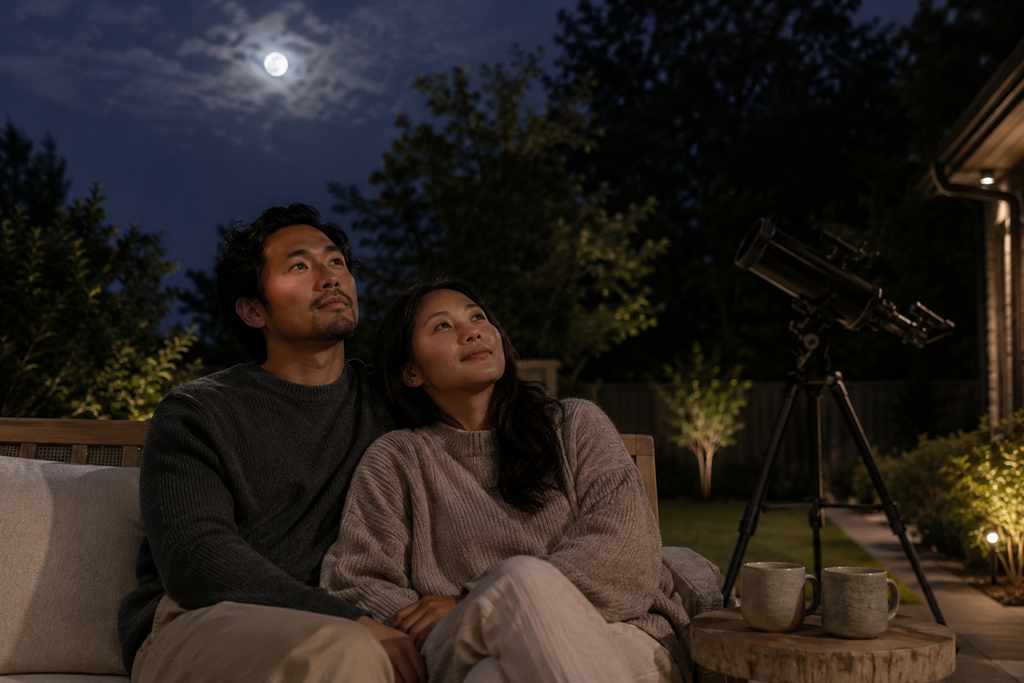
A relaxing nighttime routine around stargazing does not need to be complicated. It usually works best when you keep the evening simple: slow down before going outside, choose a comfortable viewing spot, give your eyes and mind time to adjust, and let the sky become part of your wind-down instead of another activity to manage.
For many people, the idea of stargazing sounds peaceful, but the reality can feel oddly uncertain. You may step outside, look up for a few minutes, wonder what you are supposed to notice, check your phone for answers, get distracted, feel cold, or head back inside before the moment has a chance to settle.
That does not mean stargazing is not for you. It usually means the routine around it needs to feel more comfortable, realistic, and human.
Stargazing Feels Better When The Evening Slows Down First
A peaceful stargazing routine often begins before you ever look at the sky.
If your evening is full of bright screens, unfinished chores, loud noise, and mental clutter, stepping outside can feel abrupt. Your body may be outdoors, but your attention is still moving at the speed of the day. This is why stargazing can feel more relaxing when it becomes a gentle transition rather than a sudden activity.
You might dim the lights inside, put on a warm layer, make tea, silence your phone, or take a few quiet minutes before going outside. These small choices help signal that the day is beginning to soften.
The goal is not to create a perfect ritual. It is to make the shift from “doing” to “noticing” feel easier.
Comfort Matters More Than Equipment
One common misunderstanding about stargazing is that it requires impressive gear, special knowledge, or a dramatic night sky. Those things can be enjoyable, but they are not the foundation of a relaxing routine.
Comfort is usually more important.
A chair, blanket, jacket, or quiet place to stand can change the entire experience. If you are cold, uncomfortable, rushed, or craning your neck awkwardly, the sky may be beautiful, but your body will not feel settled enough to enjoy it.
A simple backyard, balcony, porch, driveway, or nearby open space can be enough. The routine becomes more inviting when it feels easy to repeat. You are more likely to return to stargazing when it fits naturally into your life instead of feeling like a project.
Let The Sky Be Something You Notice, Not Something You Have To Master
Stargazing can become stressful when people feel they need to identify every star, constellation, planet, or moon phase right away.
Learning can absolutely be part of the enjoyment, but it does not have to dominate the experience. A relaxing nighttime routine can begin with simply noticing what is visible.
You might observe the moon’s shape, the brightness of one star compared with another, the direction clouds are moving, the color of the sky after sunset, or how quiet the neighborhood becomes at night. These observations may seem small, but they help turn stargazing into a calm practice rather than a performance.
The sky does not require you to prove anything. You can enjoy it before you understand all of it.
A Phone Can Help, But It Can Also Pull You Out Of The Moment
Astronomy apps and sky maps can be useful, especially when you want to identify a bright object or learn what is overhead. But if the purpose of the evening is relaxation, your phone can easily shift the mood.
A quick check can become scrolling. A simple search can become twenty tabs. A peaceful moment can turn into another screen-based task.
A calmer approach is to decide how much phone use belongs in the routine. You might use an app briefly before going outside, check one object during the session, or leave the phone face down unless you truly need it. This keeps technology supportive without letting it take over the evening.
The point is not to avoid tools altogether. It is to protect the quiet you came outside to find.
The Best Routine Is Easy Enough To Repeat
A nighttime stargazing routine becomes relaxing when it is simple enough to return to without effort.
That may mean ten minutes outside after dinner. It may mean stepping onto the porch once the house is quiet. It may mean watching the moon on clear nights without worrying about whether the conditions are perfect.
Many people accidentally make the routine too ambitious. They wait for the ideal sky, the perfect location, the right equipment, or a long stretch of free time. As a result, stargazing becomes something they plan but rarely do.
A more sustainable routine is smaller. It asks less from you. It gives you permission to experience the night sky in ordinary moments.
Quiet Observation Can Help The Day Feel More Complete
Stargazing is not only about astronomy. For many people, it also creates a gentle boundary between the demands of the day and the rest they need at night.
Looking up naturally changes your pace. It draws attention away from immediate tasks and toward something wider, slower, and less personal. That shift can be grounding. It reminds you that the day does not have to end in a rush of screens, chores, and unfinished thoughts.
Even a few quiet minutes outside can help the evening feel less compressed. You may not solve anything by looking at the sky, but you may feel less trapped inside the noise of the day.
That is part of why stargazing can fit so well into a nighttime routine. It gives the mind somewhere calm to rest.
Make Room For Imperfect Nights
Not every stargazing evening will feel magical. Some nights will be cloudy. Some will be too cold. Some will feel ordinary. Some evenings you may only see the moon, one bright planet, or a small patch of sky between buildings.
That does not make the routine a failure.
A relaxing routine works because it is forgiving. It allows you to step outside, notice what is there, and come back in without needing the night to become memorable. Sometimes the value is simply in pausing.
When stargazing is treated as a gentle habit rather than a special event, it becomes easier to enjoy. The sky does not need to be spectacular every time. The routine can still do its quiet work.
A Peaceful Way To Close The Day
Creating a more relaxing nighttime routine around stargazing is mostly about removing pressure.
You do not need to become an expert right away. You do not need expensive equipment. You do not need a remote location or a perfect view. You need a comfortable place, a slower pace, and a willingness to let the night sky be simple.
Over time, that simplicity can become meaningful. A few minutes under the stars can help the evening feel less rushed, the mind feel less crowded, and the day feel more gently closed.
Stargazing works best as part of a nighttime routine when it feels easy, quiet, and repeatable. Not another thing to achieve, but a small way to return to stillness.
Download Our Free E-book!