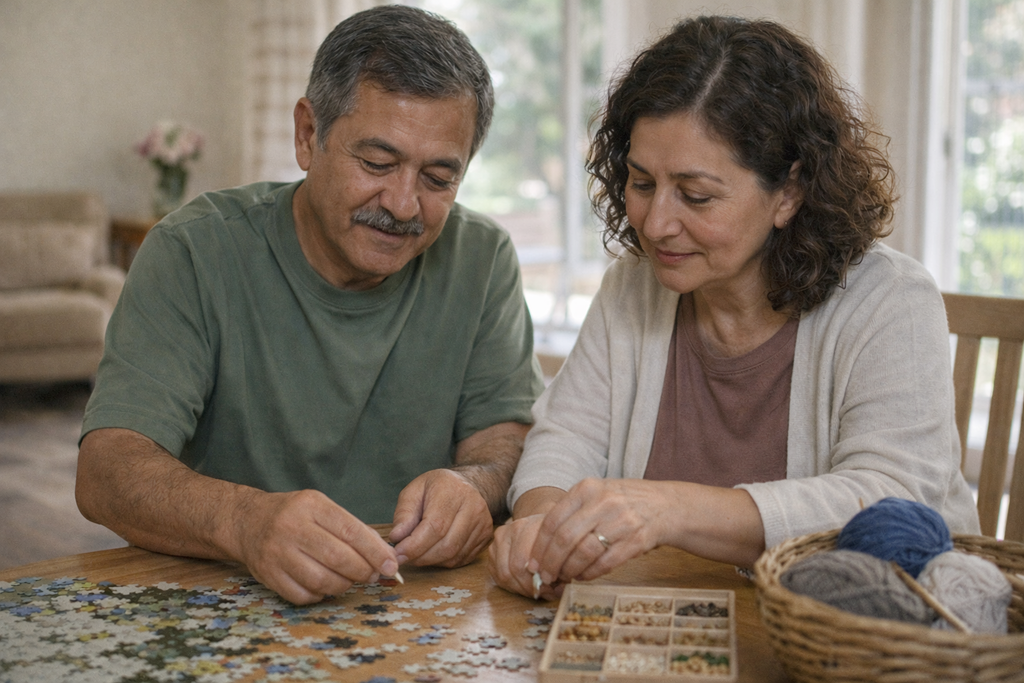
A family can stay mentally engaged without panic by treating cognitive support as part of ordinary healthy living rather than as an emergency response.
That shift matters more than it may seem. When families become worried about memory or aging, they often want to do something helpful right away. But if mental engagement starts feeling like a test, a correction, or a quiet form of monitoring, it can create more tension than support. What helps most is usually calmer and more sustainable: regular conversation, familiar routines, meaningful activity, curiosity, connection, and a household atmosphere that supports attention without making anyone feel watched.
In real life, this issue often shows up when a family wants to encourage mental sharpness but does not want every interaction to feel loaded. A spouse may not want to sound corrective. An adult child may not want to overstep. An older parent may want support without feeling managed. That middle ground can feel delicate, especially when care and worry are both present.
Mental engagement works better when it feels like life, not treatment
One of the clearest ways to reduce panic is to stop treating mental engagement as something separate from normal life.
Families sometimes imagine cognitive support as a specialized effort that has to look structured, serious, or obviously brain-focused. But in many cases, mental engagement is already woven into everyday living. Talking through plans, making meals together, keeping up with hobbies, walking through familiar neighborhoods, discussing family memories, learning something small, solving ordinary problems, and staying socially connected all ask the mind to stay active.
A helpful clarifying insight is that mental engagement tends to be more sustainable when it feels natural, relational, and dignified.
That means the goal is not to create pressure around performance. It is to protect an environment where the mind keeps participating in life. Families often recognize themselves here once they realize they do not need to turn the household into a program. They need a steadier way of supporting attention, participation, and connection.
Why panic tends to make support less effective
Panic often enters the picture when families feel responsible for preventing decline, missing signs, or doing everything right.
The intention is understandable. People care deeply, and they want to respond well. But panic changes the tone of support. It can make interactions feel overly purposeful. Activities begin carrying hidden pressure. The person at the center of the concern may feel that every conversation is being evaluated for what it proves.
That emotional atmosphere matters.
Mental engagement usually works best in the presence of calm, interest, and human connection. It tends to work less well when the person feels corrected, observed, or subtly tested. Even gentle efforts can lose their helpfulness when fear is driving them from underneath.
This is one reason families can end up discouraged. They may be trying hard to help, yet the household feels more tense rather than more supported. The issue is often not the idea of engagement itself. It is the pressure attached to it.
What supportive engagement often looks like in ordinary family life
A steadier approach usually begins with thinking less about “exercises” and more about participation.
Participation can take many forms. It may look like including someone in everyday decision-making instead of automatically taking over. It may mean making room for stories, preferences, humor, conversation, music, familiar tasks, shared outings, or low-pressure routines that keep a person mentally present in family life. It may also mean protecting sleep, reducing overwhelm, and creating a pace that makes it easier to focus rather than harder.
What matters is not whether every activity looks impressive. What matters is whether the person feels invited into life rather than managed around the edges of it.
That often leads to a much healthier family rhythm. Support becomes less performative and more relational. The focus shifts from “How do we keep a brain sharp?” to “How do we help this person stay connected, engaged, and respected in daily life?”
That is a far more human question, and usually a more helpful one.
It helps to lower the pressure around getting it exactly right
Families can become surprisingly burdened by the idea that they must find the perfect activities, the perfect routine, or the perfect response.
That pressure is rarely necessary. Mental engagement is not usually built from one ideal tool. It is built from repeated contact with meaningful life. Conversation, light responsibility, stimulation, familiarity, novelty in manageable amounts, and social connection all play a role. The family does not need to make every moment therapeutic for those things to matter.
In fact, trying too hard can make engagement feel unnatural.
A calmer posture often sounds more like this: keep life participatory, keep the tone respectful, and do not let fear turn every interaction into a project. When families relax into that mindset, people often feel more at ease and more genuinely present.
Where families often get tripped up
One common mistake is assuming that more effort always means more support.
Sometimes more effort just means more pressure. Families may introduce too much structure too quickly, over-explain simple activities, or steer every interaction toward memory, cognition, or “helpful stimulation.” Even when done lovingly, that can make a person feel handled instead of included.
Another misunderstanding is thinking that mental engagement has to look formal to count. It does not. A familiar recipe, a phone call with a friend, a walk through a favorite place, sorting photos, talking about current events, folding laundry together, or helping plan part of the week can all support mental participation in ways that feel natural and nonthreatening.
Families also get stuck when they become so worried about doing enough that they lose sight of the emotional experience they are creating. If support feels heavy, anxious, or overly controlled, it may protect no one’s peace of mind.
And sometimes people unintentionally confuse engagement with testing. They ask questions not to connect, but to see whether the person remembers correctly. That usually changes the emotional tone immediately. The interaction stops feeling supportive and starts feeling evaluative.
A calmer household often supports a more engaged mind
Mental engagement does not happen in a vacuum. It happens inside a family climate.
When the household feels rushed, tense, overly watchful, or emotionally loaded, it becomes harder for anyone to show up with ease. By contrast, when the environment feels calmer, more respectful, and less pressurized, people often participate more naturally. They speak more freely. They stay involved longer. They retain more dignity in the process.
That does not mean families should pretend concerns do not exist. It means the emotional tone surrounding those concerns matters just as much as the supportive actions themselves.
A family often helps most when it creates conditions where engagement can happen naturally rather than forcing it out of fear.
If this broader emotional strain feels familiar, the hub article, Why Fear Of Cognitive Decline Can Weigh Heavily On Family Peace Of Mind, explores why these concerns can affect an entire household, even when everyone is trying to be thoughtful and supportive.
Gentle consistency tends to do more than anxious effort
Helping a family stay mentally engaged without panic is less about doing something impressive and more about protecting a steady, human rhythm.
That usually means making engagement part of normal life, not a special performance. It means choosing connection over correction, participation over pressure, and steadiness over alarm. Families do not need to create a perfect plan in order to be helpful. They often help most when they make everyday life feel supportive, inclusive, and emotionally safe.
Often, that is what allows mental engagement to remain both meaningful and sustainable: not panic-driven effort, but calm, repeated involvement in life itself.
Download Our Free E-book!