When people want to improve their health, it is easy to fall into all-or-nothing thinking about progress. You either feel like things are working or you feel like nothing is changing. Often, that feeling gets tied too closely to the scale, a mirror, or a vague hope that your body should look different by now.
Tracking physical changes without pressure means creating a calmer, more useful way to notice what is actually happening. Instead of constantly judging your body or looking for dramatic proof, you give yourself a simple method for paying attention over time. The goal is not obsession. The goal is clarity.
That distinction matters more than many people realize.
When tracking is approached with pressure, it can turn into constant checking, discouragement, or overreaction to small changes. But when it is approached with steadiness, it becomes a tool for awareness. It helps you notice patterns, stay connected to your efforts, and make decisions based on something more useful than frustration.
Progress is often quieter than people expect
One reason physical progress feels confusing is that the body does not always change in obvious, linear ways. You may be exercising regularly, eating more consistently, sleeping better, and still feel unsure whether anything is happening.
That does not necessarily mean your effort is being wasted.
Physical change can show up gradually. Your clothes may fit a little differently before the scale shifts much. Your waist or hips may change while your overall weight stays similar. You may gain strength, hold better posture, or feel less bloated long before you see the kind of visible transformation people tend to expect.
This is where many people lose confidence. They assume that if progress is not obvious, it is not real.
In reality, subtle change is still change. Quiet progress still counts. Sometimes the most helpful thing you can do is create a way to notice what would otherwise be easy to miss.
Pressure usually comes from trying to force certainty
A lot of tracking stress comes from the belief that every measurement or check-in needs to tell a complete story. People want immediate reassurance. They want one number, one photo, or one moment to confirm that they are on the right path.
But the body does not work that neatly.
Water retention changes. Hormones change. Stress changes. Muscle gain and fat loss do not always happen at the same pace. Even posture, digestion, and sleep can affect how your body feels and looks from one week to the next.
When you expect each check-in to deliver certainty, tracking becomes emotionally loaded. A normal fluctuation feels like failure. A neutral result feels discouraging. A good week can make you feel overly confident, while a slower week can make you want to give up.
A better reframe is this: tracking is not supposed to give you instant emotional relief. It is supposed to help you collect enough information to understand your body more clearly over time.
That shift alone can make the whole process feel more grounded.
The problem is not always tracking itself
Some people avoid tracking because they assume it automatically creates pressure. For them, the answer seems simple: stop measuring anything and just go by feel.
That can work for some people in some seasons. But for many others, it creates a different kind of stress.
Without any structure, it becomes easy to rely on mood, self-criticism, or memory. On a hard day, you may assume nothing is improving. When life gets busy, you may stop paying attention altogether. And when you do want to check in, you may not have anything concrete to compare.
In other words, the problem is not always tracking. Often, the problem is tracking in a way that feels too frequent, too emotional, or too tied to perfection.
There is a middle ground between obsession and avoidance. You do not need to monitor yourself constantly, and you do not need to ignore your progress either. A simple, low-pressure system can help you stay aware without turning your body into a project that consumes your attention.
What low-pressure tracking actually looks like
Tracking physical changes without pressure usually means making the process more neutral, more spaced out, and more practical.
That might look like measuring at consistent intervals instead of checking constantly. It might mean recording basic body measurements and then moving on with your day instead of analyzing every detail. It might mean using the information as a reference point rather than a verdict on how you are doing.
The tone matters.
If you treat tracking like a test, it will probably feel tense. If you treat it like information, it becomes easier to work with. You are not gathering proof that your body is acceptable. You are simply noticing change over time.
That mindset can reduce a surprising amount of friction.
It also helps to keep the process simple. You do not need ten different apps, complicated formulas, or daily comparisons. In many cases, a basic written record is enough. When things are laid out clearly, you are less likely to overthink them.
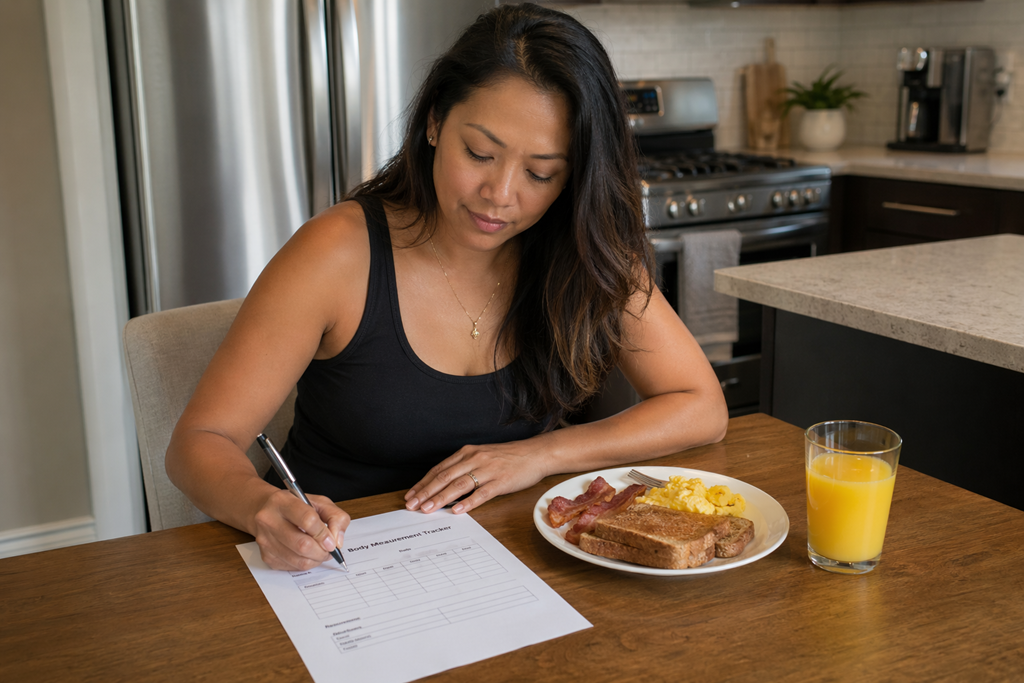
A simple Body Measurement Tracker can help here because it gives you a steady place to record changes without adding more digital noise or pressure. Used calmly, it is less about chasing numbers and more about having a clear snapshot you can return to later.
Small patterns are easier to trust when they are written down
One of the hardest parts of health progress is that memory is unreliable. You may genuinely forget where you started. You may overlook slow improvement because you see yourself every day. You may also remember the difficult weeks more vividly than the steady ones.
Writing things down gives your effort somewhere to land.
That matters because physical progress is rarely just about one moment. It is about patterns. Maybe your waist measurement is slowly changing even though your weight has stayed mostly stable. Maybe your arms and shoulders are shifting because you have been strength training more consistently. Maybe you are learning that certain routines help you feel less puffy or more comfortable in your clothes.
Those patterns are hard to recognize when everything stays in your head.
A written record creates enough distance to be more objective. It helps you step out of the emotional intensity of the present moment and look at the broader picture. That can protect you from overreacting, but it can also encourage you when the changes are real and easy to miss.
Consistency matters more than intensity here
Many people assume that being serious about progress means being highly disciplined, highly focused, and constantly engaged. But for most adults, especially those balancing work, family, stress, and real-life responsibilities, that approach is not sustainable.
What tends to work better is consistency with a lower emotional cost.
You do not need to measure every few days. You do not need to scrutinize your body. You do not need to create a high-stakes routine around progress tracking. In fact, the more emotionally charged the process becomes, the harder it often is to stick with in a healthy way.
A calmer rhythm is usually more useful. Checking in periodically, recording what you notice, and letting that be enough can help you stay connected to your goals without feeling consumed by them.
This is especially helpful for people in the improving stage, because progress is often less about getting started and more about staying steady long enough to recognize what is working. The more sustainable your system feels, the more likely you are to keep using it.
Clarity makes follow-through easier
When people say they want more motivation, what they often need is less friction.
If your only way of judging progress is emotional, follow-through becomes difficult. Every day can feel like a new debate about whether your effort is worth it. But when you have a simple way to see your progress more clearly, it becomes easier to stay grounded.
You are not relying only on hope.
You are not relying only on self-criticism.
You are not relying only on whether you feel encouraged that day.
You have a record. You have context. You have something real to refer to.
That does not mean every entry will feel exciting. It means the process becomes steadier and less confusing. And that steadiness is often what helps people keep going.
If the challenge is staying aware of subtle changes without turning the process into pressure, the right kind of structure can help. If having a simple offline way to track those patterns would make that easier, the Body Measurement Tracker can give you a clear, reusable place to record changes and stay consistent without overcomplicating the process.
Paying attention does not have to mean overthinking
There is an important difference between awareness and fixation.
Awareness says, “I want to understand what is happening.”
Fixation says, “I need constant proof that I am doing enough.”
The first creates room for learning. The second usually creates stress.
Tracking physical changes without pressure is really about protecting that difference. It allows you to stay engaged with your progress in a calm, respectful way. It reminds you that understanding your body does not require constant judgment. Often, it just requires a little structure, a little patience, and a willingness to notice what is changing over time.
That is a much steadier foundation than pressure will ever be.
Download Our Free E-book!