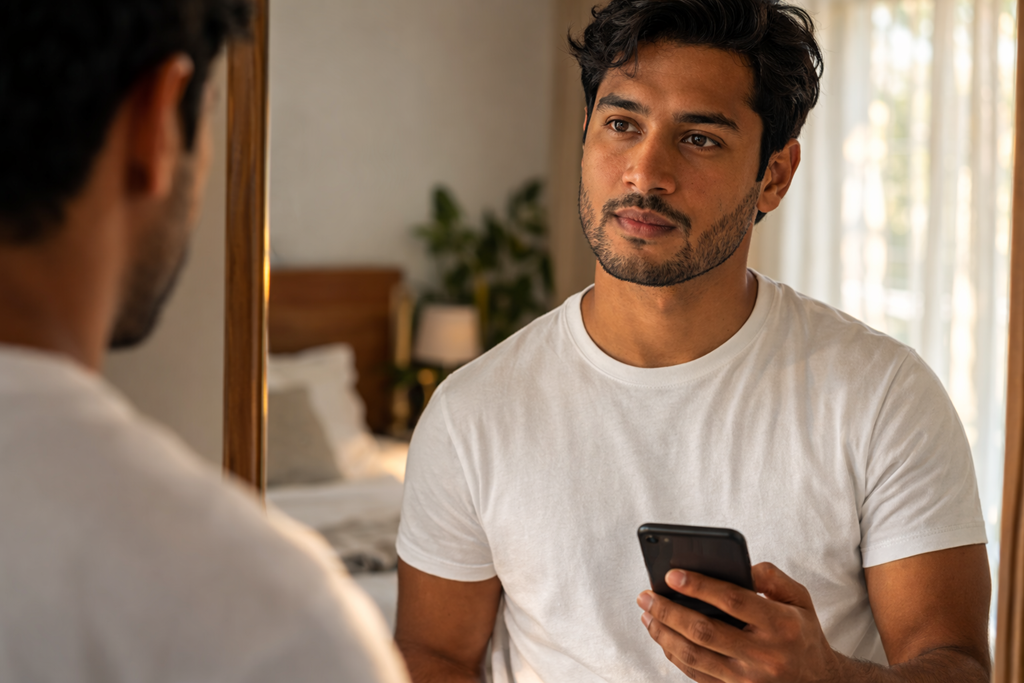
Social media comparison increases anxiety because it trains the mind to measure your life against other people’s visible highlights, progress, appearance, relationships, or success without giving you the full context behind what you are seeing. That often creates a quiet but persistent feeling that you are behind, lacking, missing out, or not doing enough, even when your own life is functioning reasonably well.
For many people, this does not feel dramatic at first. It can feel like scrolling casually and then noticing a shift in your mood. You may start out relaxed and end up tense, discouraged, self-conscious, or strangely unsettled. You may not even be consciously comparing yourself the whole time. Sometimes the effect is more subtle. You just come away feeling less secure in your own pace, your own body, your own choices, or your own progress.
A clarifying insight is that comparison on social media is often less about envy in the obvious sense and more about perceived inadequacy. The anxious feeling does not always come from wanting exactly what someone else has. Often it comes from the impression that everyone else is doing life more effectively, more attractively, or more successfully than you are. That impression can quietly raise internal pressure, even when you know intellectually that social media is selective.
Why This Matters
When this pattern goes unnoticed, people often blame themselves for the anxiety it creates. They assume they are being too sensitive, too insecure, or too easily influenced. But social comparison is not a random personal flaw. It is a predictable mental response to repeated exposure to curated images of other people’s lives.
That matters because anxiety shaped by comparison can spread into areas far beyond scrolling. A person may start second-guessing their timeline, appearance, finances, parenting, relationships, or career direction. They may feel a stronger need to prove themselves, improve faster, or stay more visibly “on track.” Over time, this can create chronic tension rather than simple momentary discomfort.
It can also distort what progress feels like. Instead of evaluating life by stability, alignment, or personal growth, people start evaluating themselves against what appears most impressive or most socially validated. That can make real progress feel insufficient, simply because it is quieter or less visible.
Another reason this matters is that the anxiety often lingers after the app is closed. The comparison may continue internally through self-judgment, rumination, or the feeling that you now need to catch up somehow. What looked like a few minutes of passive browsing can leave behind a much longer emotional residue.
Practical Guidance
One helpful reframe is to remember that social media often presents lives in display form, not lived form. What you are seeing is usually filtered through selection, timing, image control, and social context. Even when content is genuine, it is still partial. That means your internal everyday experience is often being compared against someone else’s edited external moments.
It can also help to distinguish inspiration from self-pressure. Some content genuinely offers encouragement, ideas, or perspective. Other content quietly activates deficiency. The difference matters. A useful question is not just whether something is aspirational, but whether it leaves you feeling more grounded or more unsettled.
Another supportive principle is to treat emotional aftereffects as information. If certain kinds of content repeatedly leave you more anxious, more self-critical, or more mentally agitated, that response is worth noticing. You do not need to moralize it. You can simply recognize that not all digital input has the same effect on your nervous system.
A final shift is to redefine what healthy comparison looks like. In many cases, the goal is not to eliminate all awareness of other people’s lives. It is to stop using curated visibility as the main standard for your own worth or direction. A calmer mental state often grows when people return to more personal measures of progress: stability, integrity, health, meaningful relationships, and steady growth at a human pace.
Common Mistakes Or Misunderstandings
A common misunderstanding is thinking that comparison only happens when you are openly jealous of someone. In reality, social media comparison can be much quieter than that. You may not resent anyone at all. You may simply absorb the feeling that your own life is less complete, less attractive, or less advanced than it should be.
Another easy mistake is assuming that awareness protects you completely. Many people know that social media is curated, and that insight does help. But understanding something intellectually does not always prevent an emotional effect. The nervous system can still react to repeated exposure, especially when the content touches sensitive areas like identity, success, belonging, or appearance.
Some people also believe the solution is to stop caring what others think. That idea is understandable, but it oversimplifies the issue. Humans are naturally responsive to social signals. Wanting belonging, respect, and reassurance is normal. The goal is not to become emotionally unaffected by everything. It is to recognize when a platform is amplifying comparison in ways that distort your perspective.
There is also a tendency to treat all comparison as harmful. But not all comparison works the same way. Sometimes seeing another person’s path brings clarity or motivation. The problem is not comparison in every form. The problem is repetitive exposure that increases self-doubt, internal urgency, or anxious self-monitoring.
These patterns are easy to fall into because social media blends aspiration, identity, performance, and social belonging into the same stream. Most people are not responding badly because they are weak. They are responding normally to environments that make comparison unusually constant and unusually visible.
Conclusion
Social media comparison increases anxiety because it encourages people to measure their real, lived experience against other people’s curated visibility. That often creates a lingering sense of inadequacy, pressure, or being behind, even when nothing in your actual life has suddenly become worse.
This experience is common, understandable, and more structural than many people realize. It does not mean you are failing emotionally. It usually means your mind is responding to repeated comparison cues that quietly raise internal pressure.
If you’d like the bigger picture, the hub article on why digital overload is quietly increasing daily stress explores how social media comparison fits into a broader pattern of everyday mental strain.
Download Our Free E-book!