Decluttering your kitchen counters does not mean clearing off everything and hiding the items you use every day. The goal is to remove what gets in the way while keeping your kitchen easy to cook in, clean, and live with.
A useful kitchen is not always a perfectly empty kitchen. Some things deserve to stay within reach because they support your real routines. The problem usually begins when your counters stop serving your routines and start collecting everything that does not have a better home.
That is the difference between a clear counter and a useful counter.
A Clear Counter Is Not the Same as a Functional Kitchen
It is easy to look at photos of spotless kitchens and assume the solution is to remove almost everything. But most people do not live inside a staged kitchen. They make coffee, pack lunches, sort mail, cook dinner, unload groceries, take vitamins, feed pets, and clean up after busy days.
When counters get cluttered, the issue is rarely that you own one wrong item. It is usually that too many decisions are happening in the same small space.
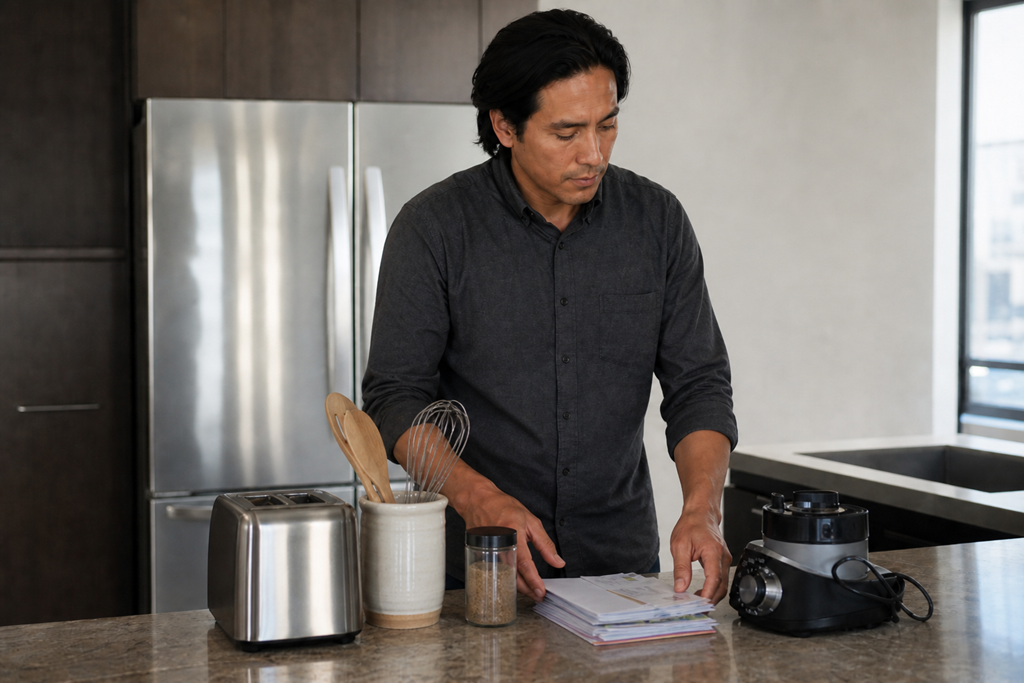
The coffee maker is next to the mail pile. The toaster is beside school papers. The fruit bowl is mixed with receipts. The cutting board has nowhere to go. A few things are useful, a few things are temporary, and a few things have quietly become permanent because nobody decided where they should live.
Decluttering kitchen counters works best when you separate those categories instead of treating everything as clutter.
The Real Question Is What Your Counters Need to Support
Before removing things, it helps to ask a calmer question:
What do I actually need this counter space to help me do?
For most homes, kitchen counters need to support a few basic activities:
- preparing food
- making coffee or tea
- serving meals or snacks
- unloading groceries
- washing or drying dishes
- handling a few daily household items
That does not mean every related object needs to sit out all the time. It means your counter should make those activities easier, not harder.
A knife block might make sense if you cook often and have enough space. A bulky mixer may not deserve counter space if you only use it once a month. A fruit bowl may be helpful if your family eats from it daily, but it becomes visual clutter if it mostly holds random items.
The point is not to follow someone else’s kitchen rules. The point is to notice what supports your actual life.
Why Counters Become Cluttered So Quickly
Kitchen counters are one of the easiest places in the home to clutter because they are open, visible, and convenient. They are flat surfaces in a high-traffic room, which makes them natural landing zones.
A counter can become the place for:
- things you plan to put away later
- items that do not have a clear home
- appliances you feel guilty storing
- papers you do not want to lose
- objects that belong in another room
- half-finished tasks
- “temporary” piles that stop feeling temporary
This is why counter clutter can feel so frustrating. It is not just visual mess. It is unfinished decision-making.
Every item sitting there asks for a small decision. Keep it out? Put it away? Move it somewhere else? Throw it away? Use it soon? Deal with it later?
When too many of those decisions build up, the kitchen starts to feel harder to use even before you begin cooking.
Keep the Items That Earn Their Place
A helpful way to declutter kitchen counters is to stop asking, “Can this be on the counter?” and start asking, “Does this earn counter space?”
An item earns counter space when it is used often, supports a daily routine, and does not make the area harder to clean or use.
For example, a coffee maker may earn its place if coffee is part of your daily morning rhythm. A small tray for cooking oils may make sense if it keeps frequently used items contained near the stove. A fruit bowl may work well if it encourages healthier snacks and stays manageable.
But some items sit out because they are heavy, awkward, sentimental, expensive, or simply never got moved after the last time they were used. Those items may still be useful, but they may not need prime counter space.
Counter space is valuable because it supports movement. If an item blocks prep space, makes wiping down the surface annoying, or crowds the area where you cook, it may be useful but poorly placed.
The Most Useful Counters Usually Have Breathing Room
A kitchen does not need to be empty to feel calm. It needs enough open space to function.
Open counter space gives you room to chop vegetables, set down groceries, plate food, pack lunches, or clean without moving five things first. It also makes the room feel less mentally noisy.
This is where many people get stuck. They think they need more storage before they can declutter. Sometimes more storage helps, but often the first improvement comes from reducing what is visible.
A counter with three intentional items usually feels better than a counter with ten semi-useful items. The kitchen becomes easier to clean, easier to move through, and easier to reset at the end of the day.
Breathing room is not wasted space. It is working space.
Be Careful With “Convenient” Items That Create More Work
Some counter clutter stays because it seems convenient. The problem is that convenience can become clutter when too many items are kept out “just in case.”
This often happens with small appliances, vitamins, spices, utensils, water bottles, mail, charging cords, and snack containers.
Each item may have a reasonable explanation. But together, they can make the kitchen feel crowded and harder to maintain.
A good test is to ask:
Does keeping this out save more effort than it creates?
If the toaster is used every morning, keeping it out may save effort. If the blender is used twice a month but takes up a full corner, storing it elsewhere may make the kitchen easier every day. If vitamins are always forgotten in a cabinet, a small contained setup may help. But if five bottles spread across the counter, the system may need a better boundary.
Convenience is useful only when it stays contained.
Give Daily Items a Boundary, Not Unlimited Space
Some items genuinely need to stay on the counter. The key is giving them a clear boundary.
A tray, small basket, corner, shelf, or designated zone can turn loose clutter into a controlled setup. This works especially well for coffee supplies, cooking oils, fruit, vitamins, dish soap, or a small drop zone.
The boundary matters because it prevents slow spreading. Without a limit, one useful item attracts another. Then another. Soon the counter becomes a collection of things that are almost related but not truly organized.
A boundary quietly says, “This is the amount of space this routine gets.”
That is often more realistic than trying to keep the counter completely empty.
Watch for the Drop Zone Problem
Many kitchen counters are not cluttered because of kitchen items. They are cluttered because the counter has become the easiest place to drop everything from daily life.
Mail, keys, sunglasses, receipts, school forms, batteries, cords, and random small objects often land in the kitchen because it is central and convenient.
If that is happening, the solution is not only kitchen organization. The solution is to create another place for those items to land.
A small entryway bowl, paper tray, wall pocket, charging station, or command center can help redirect non-kitchen clutter. Even a simple basket near the doorway can reduce what ends up on the counter.
The important part is not perfection. It is giving common clutter a more logical destination than the kitchen prep surface.
Do Not Hide Everything Just to Make the Kitchen Look Better
One common decluttering mistake is clearing the counters so aggressively that the kitchen becomes annoying to use.
If you have to dig through a cabinet every morning for the coffee filters, pull out a heavy appliance every day, or move everyday tools to an inconvenient spot, the counter may look better but function worse.
That kind of decluttering rarely lasts because it fights your routines.
A better approach is to keep your most repeated habits easy while removing the things that do not support those habits. This creates a kitchen that looks calmer and works better.
The goal is not to impress anyone with how little is visible. The goal is to make your kitchen easier to live in.
A Good Counter Setup Should Be Easy to Reset
One sign that your kitchen counters are working well is that they are easy to reset.
You should be able to wipe them down without a major rearranging session. You should have enough open space to prepare food. You should know where the usual items belong. You should not have to clear piles before using the kitchen for normal tasks.
That does not mean the counters will stay clear every minute. Real kitchens get used. Groceries come in. Meals get made. Papers appear. Dishes pile up.
But a functional counter setup makes it easier to return the kitchen to order because fewer things are permanently in the way.
A reset-friendly kitchen is more useful than a picture-perfect one.
Start With the Items That Interrupt Daily Life
If your counters feel overwhelming, do not begin by trying to solve the whole kitchen. Start with the items that interrupt everyday use.
Look for the things that:
- block your main prep area
- make cleaning harder
- sit out but are rarely used
- belong in another room
- create visual noise
- attract more clutter
- make you move items before cooking
These are usually the best first candidates to remove, relocate, or contain.
You do not have to make every counter perfect. Even clearing one main work area can make the kitchen feel more usable.
A Useful Kitchen Has Room for Real Life
Decluttering kitchen counters is not about creating a showroom kitchen. It is about making the space easier to use, easier to clean, and easier to return to calm after daily life happens.
Some items can stay. Some need a better boundary. Some need to move. Some do not belong in the kitchen at all.
The most helpful counter setup is one that supports your actual routines without letting every routine take over the whole surface.
When your counters have enough breathing room, your kitchen becomes less frustrating. You can cook with less resistance, clean with less effort, and move through the room without constantly managing piles.
That is the real purpose of decluttering kitchen counters: not emptiness, but ease.
Download Our Free E-book!