Keeping your joints healthy as you age is less about doing one perfect exercise or following a complicated routine, and more about protecting your ability to move comfortably in everyday life. The biggest supports are steady movement, stronger muscles, flexibility, healthy body weight, enough recovery, and paying attention when pain is trying to tell you something.
That may sound simple, but it is easy to misunderstand. Many people assume joint care only matters once something hurts, or they worry that movement will make aging joints worse. In reality, the right kind of movement can help support strength, balance, function, and daily comfort. Mayo Clinic notes that exercise can strengthen the muscles around joints, support bone strength, improve balance, help with weight control, and make daily life easier for people managing arthritis symptoms.
Joint health is not about trying to keep your body young forever. It is about helping your body stay usable, supported, and trusted as your life changes.
Healthy Joints Are About Everyday Movement, Not Perfect Fitness
When people think about joint health, they often picture workouts, stretches, supplements, or medical conditions. But in real life, joint health usually shows up in smaller moments.
It shows up when you get out of bed and your knees feel stiff. It shows up when your hips feel tight after sitting too long. It shows up when your shoulders complain after carrying groceries, or when your ankles feel less steady than they used to.
These moments do not always mean something is seriously wrong. They can be signs that your joints, muscles, and movement habits need more consistent support.
Aging joints often need a mix of three things: movement to keep them from getting too stiff, strength to help support them, and enough recovery so you are not constantly asking irritated areas to do more than they are ready for.
Movement Helps Keep Joints From Becoming More Limited
One of the most helpful ideas to understand is that joints are made to move. When movement disappears from daily life, stiffness can become more noticeable. That does not mean you need intense workouts. It means your body benefits from regular, reasonable motion.
Walking, gentle cycling, swimming, water aerobics, stretching, and light strength work can all be joint-friendly options depending on your body and your current fitness level. The CDC states that physical activity can help people with arthritis reduce joint pain and improve function and mood, while also encouraging adults to move more and sit less throughout the day.
That point matters because many people respond to joint discomfort by becoming less active. Sometimes rest is needed, especially after an injury or flare-up. But long-term avoidance can create a difficult cycle: less movement can lead to weaker muscles, more stiffness, poorer balance, and less confidence moving.
A calmer approach is to look for the amount and type of movement your body can tolerate well, then build from there gradually.
Strong Muscles Take Pressure Off Your Joints
Your joints do not work alone. They are supported by muscles, tendons, ligaments, and the way your body moves as a whole.
When the muscles around a joint are stronger, they can help absorb and manage some of the load that would otherwise go directly into the joint. This is one reason strength training can be helpful as people age. Mayo Clinic explains that having strong muscles around joints can help take load off the joints, while also cautioning that people should exercise within reason and avoid overdoing high-volume or high-intensity activity.
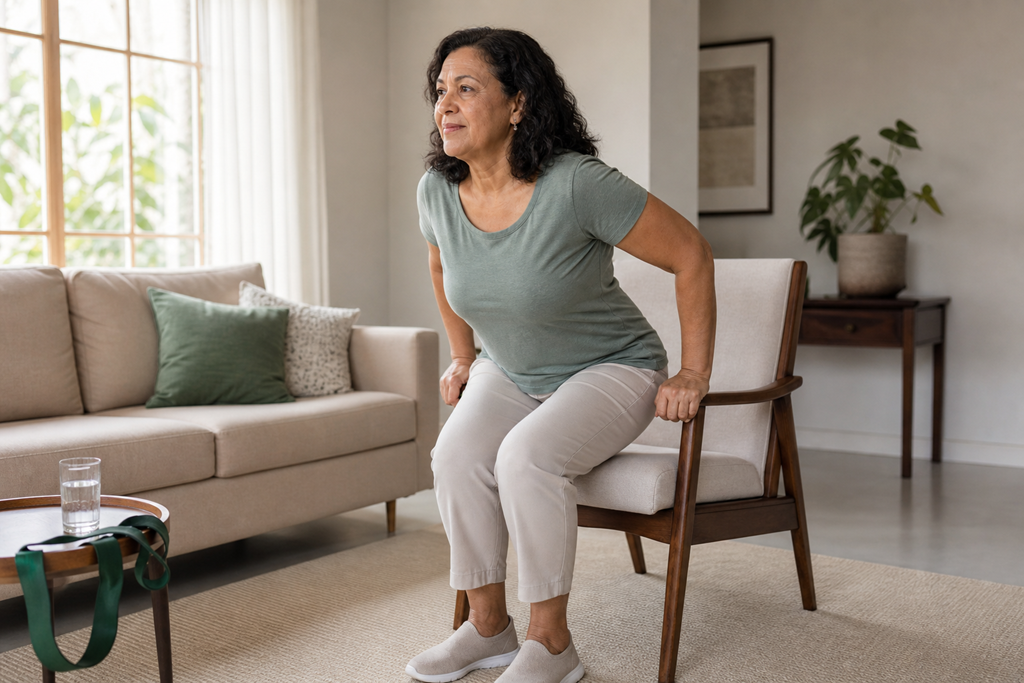
This does not mean you need to become a weightlifter. For many adults, strength support can begin with simple, controlled movements: sitting down and standing up from a chair, using resistance bands, doing gentle wall pushups, carrying groceries safely, or practicing light lower-body exercises with good form.
The goal is not to punish your joints. The goal is to help the rest of your body become strong enough to support them.
Flexibility Matters, But Stretching Is Not the Whole Answer
Stretching can help, especially when stiffness is part of the problem. But flexibility by itself is not the entire story.
A joint may feel tight because the surrounding muscles are stiff. It may also feel tight because the area is weak, irritated, underused, overused, or not moving well through its normal range. That is why a thoughtful joint-health routine usually includes more than stretching alone.
The National Institute on Aging describes three major types of exercise that can support older adults: aerobic activity, muscle-strengthening activity, and balance exercises. Mayo Clinic also notes that flexibility exercises can help joints keep moving and that balance exercises may help lower fall risk.
For everyday life, that means a balanced approach may be more useful than chasing one perfect solution. A short walk, a few gentle mobility movements, and simple strength work may do more for long-term joint confidence than occasional intense stretching sessions.
Joint Health Is Also Affected by Weight, Posture, and Daily Habits
Joint health is not only about exercise. Your joints respond to the way you use your body throughout the day.
Sitting for long periods, skipping movement for days at a time, suddenly doing too much on the weekend, carrying heavy bags on one side, wearing unsupportive shoes for long walks, or ignoring poor posture during repetitive tasks can all make joints feel more stressed.
Body weight can also matter, especially for weight-bearing joints like knees, hips, ankles, and feet. This does not need to become a shame-based conversation. The practical point is that joints experience load. Even small improvements in strength, movement, and weight management can sometimes make daily movement feel more comfortable.
The key is to avoid turning joint care into an all-or-nothing project. You do not need to overhaul your entire life to support your joints. You need habits that make movement easier to repeat.
Pain Is Information, Not a Character Test
A common mistake is treating joint discomfort as something to ignore until it becomes impossible to ignore. Another mistake is assuming every ache means you should stop moving completely.
Pain deserves attention, but it also needs context. Some mild muscle soreness after new activity can be normal. Sharp pain, swelling, sudden weakness, loss of function, pain after an injury, or discomfort that keeps getting worse should be taken more seriously.
For LifeStylenaire’s practical purposes, the useful reframe is this: pain is information. It is not proof that you are failing, and it is not something you need to “push through” to prove discipline.
If an activity repeatedly leaves a joint more painful, swollen, unstable, or irritated, that activity may need to be adjusted. That might mean changing intensity, range of motion, surface, footwear, frequency, or technique. It may also mean asking a qualified healthcare professional or physical therapist for guidance.
The Biggest Joint-Health Mistake Is Doing Too Much or Too Little
Many people swing between two extremes.
One extreme is avoidance: moving less and less because joints feel stiff or unreliable. The other extreme is overcorrection: starting a new exercise routine too aggressively, doing too much too soon, and then stopping because the body feels worse.
Healthy aging usually lives between those extremes.
Your joints often respond better to consistency than intensity. A gentle routine you can repeat is usually more valuable than an ambitious routine you abandon after two weeks. This is especially true if you are rebuilding movement after a long inactive period.
A joint-supportive lifestyle might look ordinary: walking most days, standing up from your desk more often, doing simple strength exercises a few times a week, stretching gently, sleeping enough, staying hydrated, and adjusting activity when your body gives you feedback.
None of that is flashy. But it is the kind of practical support that can matter over time.
You Do Not Have to Wait Until Your Joints Hurt
Joint care is often treated as a reaction to pain. But it can also be part of normal healthy aging.
If your joints feel fine right now, that is still a good reason to build supportive habits. Stronger muscles, better balance, flexible movement, and regular activity can help you keep doing ordinary things with more confidence: walking, gardening, traveling, climbing stairs, cleaning the house, playing with grandchildren, exercising, or simply moving through your day without feeling as limited.
The goal is not to prevent every ache. Bodies change. Some stiffness, soreness, or adjustment may happen with age. But you can still support your joints in a way that helps you feel more capable and less afraid of movement.
A More Supportive Way to Think About Joint Health as You Age
Keeping your joints healthy as you age does not require a complicated routine. It asks for steady care.
Move regularly. Strengthen gently. Stretch enough to stay mobile. Avoid long stretches of inactivity. Do not ignore pain that keeps returning. Give your body time to adapt. Choose exercises that fit your current ability instead of forcing yourself into someone else’s version of fitness.
Most of all, remember that joint health is not about perfection. It is about preserving comfort, confidence, and independence in the life you are actually living.
Aging well is not just about adding years. It is about making your everyday movements feel more supported along the way.
Download Our Free E-book!