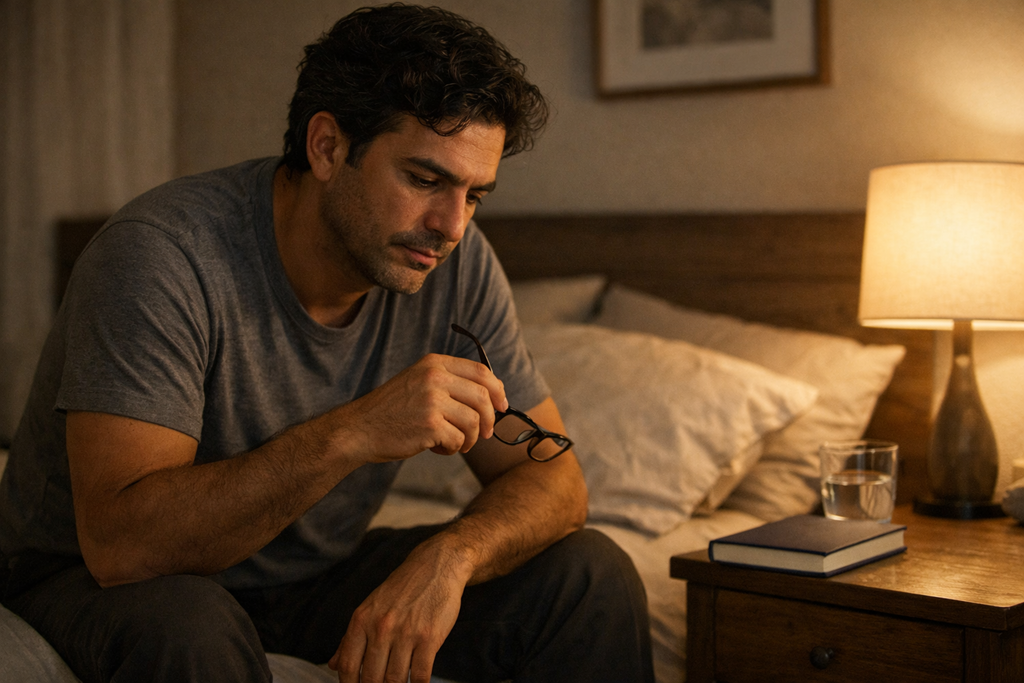
There is a particular kind of sleeplessness that does not begin with noise, caffeine, a bad mattress, or even a difficult schedule. It begins with awareness.
You notice that you are still awake. You notice how late it feels. You notice that tomorrow matters. Then the mind starts moving faster than the body can settle. You try to relax, try not to think, try not to care so much, and yet the effort itself seems to make sleep feel even farther away.
This is one of the most frustrating parts of sleep anxiety. The problem is not only that you are not sleeping. It is that the fear of not sleeping can become an active part of what keeps you awake.
That can feel confusing, especially for people who are trying hard to do the right things. They may be going to bed on time, cutting back on screens, making the room darker, avoiding late caffeine, or reading about better sleep habits. But if bedtime has quietly become a moment of pressure, monitoring, and fear, the body may stop relating to bed as a place of safety and start relating to it as a place of evaluation.
That does not mean anything is wrong with you. It means your nervous system may be responding exactly the way nervous systems often respond when rest starts to feel high-stakes.
When bedtime starts to feel like a test
Sleep becomes much harder when it stops feeling natural and starts feeling consequential.
For many people, that shift happens gradually. A few rough nights lead to understandable concern. Then concern turns into watchfulness. You begin checking how tired you feel, estimating how many hours are left, calculating how tomorrow will go if sleep does not come soon. You may try to force yourself into the “right” state for sleep, only to feel more awake when it does not happen quickly.
At that point, the night is no longer just a stretch of time in which sleep might arrive. It starts to feel like a performance you need to succeed at.
That inner pressure matters. Sleep is not a task the mind can complete through intensity. It is a state the body moves toward more easily when it feels safe enough to let go. The more strongly you grip for it, the more alert the system can become.
This is why sleep anxiety often feels so unfair. The harder you try to prevent a bad night, the more your own effort can signal that there is something to worry about.
Your body may be reacting to pressure, not failing at sleep
A helpful reframe is this: in many cases, the problem is not simply a lack of sleep ability. It is an increase in sleep-related threat.
When the brain starts associating nighttime with frustration, vigilance, or dread, the body may respond with more activation rather than less. Heart rate can feel more noticeable. Thoughts can speed up. Physical sensations that would normally fade into the background may suddenly feel impossible to ignore. Even the question Will I sleep tonight? can be enough to keep the system on alert.
This helps explain why effort alone has not fixed the issue. You cannot pressure a guarded nervous system into deeper rest. You can improve conditions for sleep, but sleep itself does not respond well to fear-based control.
In that sense, anxiety about not sleeping is not just a reaction to insomnia. It can become part of the cycle that sustains it.
The goal, then, is not to win a nightly battle. It is to reduce the sense of threat that has become attached to the night.
If you want a deeper, steadier framework for that process, the LifeStylenaire member guide, A Calmer Approach To Sleep Anxiety And Nighttime Pressure, explores this pattern in more depth and offers additional support. It is there if you want more structure, not because you need to do more tonight.
Why good sleep habits do not always solve this right away
People with sleep anxiety are often told to improve their habits, and sometimes that advice is useful. But it can also feel incomplete.
Sleep hygiene matters, but it does not fully address what happens when fear becomes part of the bedtime experience. Someone can have a cool room, a consistent routine, and no phone in bed, and still lie awake because the deeper issue is not only behavior. It is the meaning the body has started attaching to the situation.
If bedtime now carries messages like This has to go well, I cannot afford another bad night, or I need to make sleep happen, then the system may stay more alert than the person realizes.
This is one reason people can become discouraged. They assume that if the usual advice has not worked, they must be doing something wrong or their sleep is fundamentally broken. In reality, they may be dealing with a different layer of the problem. The issue is not just poor habits. It is the escalating pressure surrounding sleep itself.
That distinction matters because it changes the direction of help. Instead of only asking, How do I optimize sleep? it becomes more useful to ask, How do I stop turning sleep into a threat-sensitive event?
The mistake is usually not caring too much, but relating to sleep through fear
Many people blame themselves for becoming “too obsessed” with sleep. There is often some truth in the idea that sleep has taken up too much mental space, but self-criticism usually makes the pattern worse.
Most people do not become preoccupied with sleep for irrational reasons. They become preoccupied because sleep affects mood, focus, patience, work, parenting, physical comfort, and the ability to feel like themselves. Of course it starts to matter. Of course a rough stretch can make someone anxious.
The more accurate issue is not that you care too much. It is that concern has gradually turned into a fear-based relationship with sleep.
That relationship can show up in subtle ways:
- watching the clock to measure loss
- mentally bargaining with the night
- trying to force relaxation
- treating wakefulness as immediate evidence of failure
- assuming that one difficult night will ruin the next day
- looking for certainty that sleep is coming before the body has actually settled
These responses are understandable. They are also activating. They teach the system that nighttime is a place where something important is at stake.
A common misunderstanding is that sleep must be controlled to become reliable
One of the most persistent misconceptions around sleep anxiety is the belief that better sleep will come from better control.
Control sounds sensible. It sounds responsible. But sleep is not like finishing a task, solving a problem, or staying on top of a schedule. It is a biological process that tends to unfold more smoothly when the body is not being tightly managed moment by moment.
This is why people often end up stuck between two exhausting roles at night: observer and enforcer. One part of the mind monitors every sign of wakefulness, while another part tries to correct it. That can create a constant loop of checking, reacting, and trying harder.
A calmer and more useful perspective is that sleep becomes more reliable not when every night is perfectly managed, but when the body no longer experiences bedtime as a place of struggle.
That does not mean doing nothing. It means shifting away from force and toward conditions that communicate safety, patience, and less internal urgency.
The deeper task is rebuilding a safer relationship with the night
For many people, progress begins when the goal changes.
Instead of making the night about achieving sleep at all costs, it becomes about reducing alarm around wakefulness. Instead of treating every restless moment as proof that something is going wrong, the aim becomes to soften the meaning attached to those moments.
This is often less dramatic than people expect. It may involve learning to notice the surge of sleep-related fear without fully obeying it. It may involve recognizing that a wakeful night feels threatening partly because the mind is projecting forward into tomorrow. It may involve allowing the body to remain imperfectly awake without immediately turning that into a crisis.
That kind of shift can feel small, but it changes the emotional climate around sleep.
A useful high-level framework often includes four quieter moves:
Seeing the cycle clearly instead of blaming yourself
Sleep anxiety tends to feel personal, as if your mind is uniquely broken or your body has forgotten how to rest. In reality, the pattern is often very understandable. Poor sleep creates fear. Fear increases arousal. Arousal makes sleep less likely. Another difficult night then reinforces the fear.
When the cycle becomes visible, shame usually loses some of its power.
Separating wakefulness from catastrophe
One hard part of sleep anxiety is that wakefulness rarely stays in the present. The mind turns it into prediction. You are not only awake now. You are already imagining tomorrow’s exhaustion, mistakes, irritability, or inability to function.
That leap intensifies the night. Softening it can reduce pressure, even when sleep is still not immediate.
Reducing performance pressure around rest
The more sleep feels like something that has to be achieved, the harder it often becomes to drift toward it. Many people need less bedtime effort, not more. Less monitoring. Less forcing. Less internal commentary about how the night is going.
Relearning that the body can settle without being commanded
A pressured mind often stops trusting the body. It starts trying to manually supervise a process that is usually more automatic. Part of recovery is slowly rebuilding confidence that the body still knows how to move toward rest, even after a difficult stretch.
That trust may not return all at once. But it usually returns more easily when it is not being demanded.
What forward movement often looks like in real life
Progress with sleep anxiety does not always look like instant perfect sleep. More often, it looks like a gradual reduction in panic, urgency, and constant mental involvement.
You may still have hard nights, but they stop feeling as loaded. You may notice wakefulness without immediately spiraling into prediction. Bedtime may begin to feel less like a checkpoint and more like a transition. Even before sleep becomes more consistent, the relationship to sleep often becomes less fearful.
That matters more than many people realize.
When the nervous system feels less threatened by the possibility of being awake, it becomes easier for sleep to happen in a more ordinary way. The night stops being a contest between exhaustion and fear.
This is often the turning point: not when someone discovers the perfect trick, but when sleep is no longer treated as a fragile outcome that must be tightly controlled.
You are not failing if sleep feels harder the more you chase it
There is a painful irony in sleep anxiety. The person who wants sleep the most and tries the hardest to protect it can end up feeling the least able to access it.
That does not mean they are weak, dramatic, or doing bedtime wrong. It means the fear surrounding sleep has started to interfere with the very state they are trying to reach.
Recognizing that can be relieving. It means the answer may not be to care more, monitor more, or optimize more. It may be to step out of the pressure loop and begin changing the way the night is understood.
Sleep is not always restored through force. Sometimes it begins to return when fear loses some of its authority.
And for many people, that is where real hope starts: not in mastering the night, but in no longer treating it like an emergency.
Download Our Free E-book!