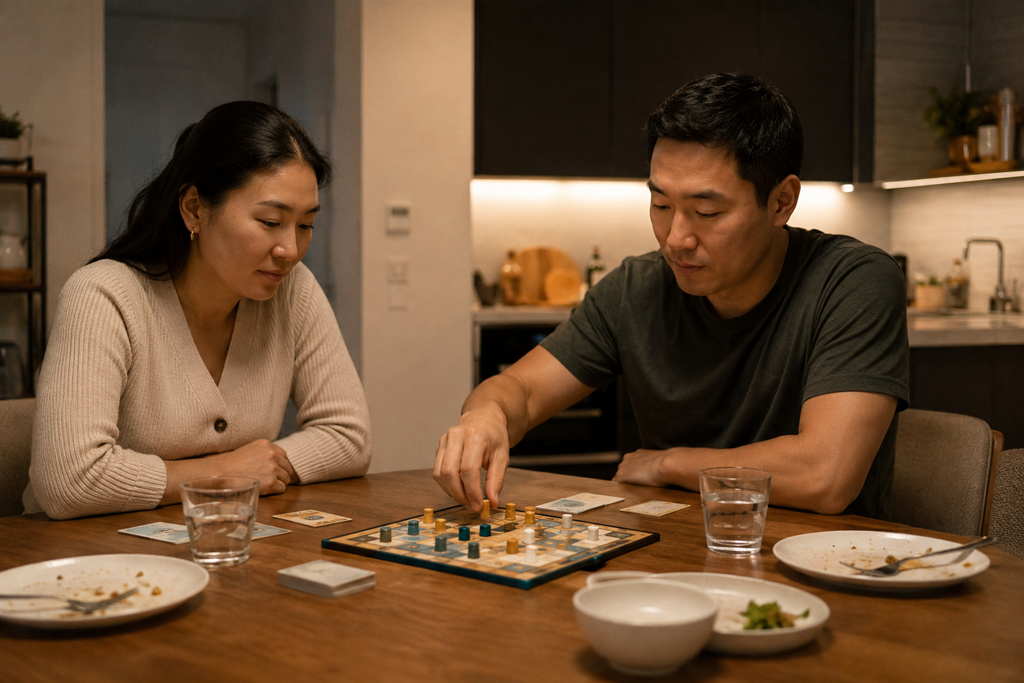
Many people use board games to slow down and reconnect because they create a simple reason to sit together, focus on one shared activity, and step away from the usual noise of screens, errands, work, and distracted conversation.
At their best, board games are not really about winning. They are about creating a small pocket of shared attention. Everyone agrees, even briefly, to gather around the same table, follow the same rhythm, and be present in the same moment.
That is why board games can feel surprisingly meaningful. They give people something structured enough to do, but relaxed enough to enjoy. They make connection feel less forced.
The Quiet Appeal Of Sitting Around A Table Again
Modern life often keeps people physically close but mentally scattered. A family may be in the same house, but one person is answering messages, another is watching videos, another is finishing work, and someone else is scrolling without really noticing it.
A board game interrupts that pattern in a gentle way.
It asks people to sit down, look at the board, take turns, make small decisions, laugh at unexpected moments, and pay attention to each other. The experience can be simple, but the shift is real. Instead of everyone orbiting their own private distractions, the table becomes a shared center.
For many people, that is the emotional draw. Board games create togetherness without requiring a deep conversation to begin.
Board Games Make Slowing Down Feel Natural
One reason people struggle to slow down is that stillness can feel awkward. Sitting together with no plan may sound nice, but in real life it can quickly become uncomfortable. Someone reaches for a phone. Someone turns on the TV. Someone feels pressure to “make the moment meaningful.”
A board game removes some of that pressure.
The game gives the group a light structure. There are cards to draw, pieces to move, turns to take, and choices to make. That structure makes it easier to relax because nobody has to invent the entire social experience from scratch.
This is especially helpful for people who want connection but do not always know how to create it. A game offers a shared focus, so connection can happen naturally in the background.
The Reconnection Often Happens Between Turns
The most meaningful part of a board game night is not always the game itself.
It may be the small comments between turns. The inside jokes. The way someone explains a rule patiently. The playful frustration when a plan falls apart. The casual conversation that starts while someone is thinking through their next move.
These small moments matter because they feel low-pressure. People are not being asked to “open up” on command. They are simply spending time together in a setting where attention, humor, and conversation have room to return.
That is why board games can work well for couples, families, friend groups, roommates, and even multigenerational gatherings. The game becomes a bridge.
It Is Not About Being A Serious Hobbyist
A common misunderstanding is that board games are only for people who know lots of rules, own shelves of games, or enjoy long strategy sessions.
That can be part of the hobby, but it is not required.
Many people use board games in a much simpler way. They use them to make an evening feel warmer. They use them to create a screen-free family moment. They use them to reconnect with friends without needing a big plan. They use them because the table feels calmer than another night of everyone half-watching something.
You do not have to become a collector, strategist, or expert to benefit from board games. A familiar game, a relaxed pace, and the right people can be enough.
Games Give People Permission To Be Playful Again
Adults often have fewer chances to be playful in everyday life. Responsibilities pile up. Conversations become practical. Time together can revolve around logistics, schedules, bills, chores, and problem-solving.
Board games create a socially acceptable way to be playful again.
They allow people to tease gently, take silly risks, celebrate small wins, and laugh at harmless setbacks. This matters because play can soften the atmosphere in a room. It can make people feel less guarded. It can bring out parts of a relationship that get buried under routine.
This does not mean every game night has to be loud or funny. Some games are quiet and thoughtful. Others are cooperative. Some are competitive but lighthearted. The important part is that the game gives people a different mode of being together.
The Slower Pace Can Feel Restorative
Many daily activities move quickly. Messages need replies. Work tasks stack up. News cycles update constantly. Entertainment is often designed to keep attention jumping from one thing to the next.
Board games move differently.
They usually require patience. You wait your turn. You consider a choice. You notice what someone else is doing. You stay with the same activity for more than a few minutes.
That slower rhythm can feel restorative because it gives the mind fewer places to scatter. Even a simple game can help create a sense of pause. The table becomes a boundary between the rush of the day and a quieter kind of attention.
For people who feel overstimulated, that slower rhythm may be one of the biggest benefits.
The Best Game For Reconnection Is Usually Not The Most Impressive One
Another pattern that can make board game nights harder than they need to be is choosing a game that is too complicated for the moment.
Sometimes people want the evening to be special, so they pick something big, elaborate, or unfamiliar. But if the group is tired, distracted, or mixed in experience level, a complicated game can create frustration instead of connection.
For reconnecting, the best game is often the one people can actually enjoy together.
That might mean a shorter game. A familiar game. A cooperative game. A party game with easy rules. A gentle strategy game that does not require everyone to study instructions for half an hour.
The goal is not to prove how interesting the game collection is. The goal is to create a shared experience that people are willing to return to.
Board Games Can Help Without Fixing Everything
It is important not to overstate what board games can do.
A board game will not automatically repair a strained relationship, solve a family conflict, or replace deeper conversations that need to happen. It is not a cure for loneliness or disconnection.
But it can help create conditions where connection feels easier.
It can make the room warmer. It can lower the barrier to spending time together. It can give people a reason to put their phones aside. It can bring a little humor back into a routine that has become too practical or too rushed.
Sometimes that is enough for one evening. And sometimes one easier evening makes the next one easier too.
Why This Simple Habit Keeps Appealing To People
People keep returning to board games because they offer something many people quietly miss: shared attention.
Not perfect attention. Not deep emotional intensity. Not a polished event.
Just a table, a game, a few people, and a reason to be present together for a while.
In a busy life, that can feel surprisingly grounding. Board games slow the room down. They make connection feel approachable. They remind people that time together does not always need to be complicated to matter.
For many board game enthusiasts, that is the real beauty of the hobby. The game is on the table, but the deeper value is often what happens around it.
Download Our Free E-book!