Munich is one of those cities that works especially well for first-time visitors. It has grand historic squares, excellent museums, relaxed parks, beautiful palaces, traditional food, and easy day trips—all without feeling as difficult to navigate as some larger European capitals.
This guide focuses on the best things to do in Munich if it’s your first visit. The goal is not to pack every hour, but to help you choose experiences that give you a real sense of the city: its history, Bavarian culture, architecture, green spaces, and everyday rhythm.
Start With Munich’s Historic Center
1)) Explore Marienplatz and the Old Town
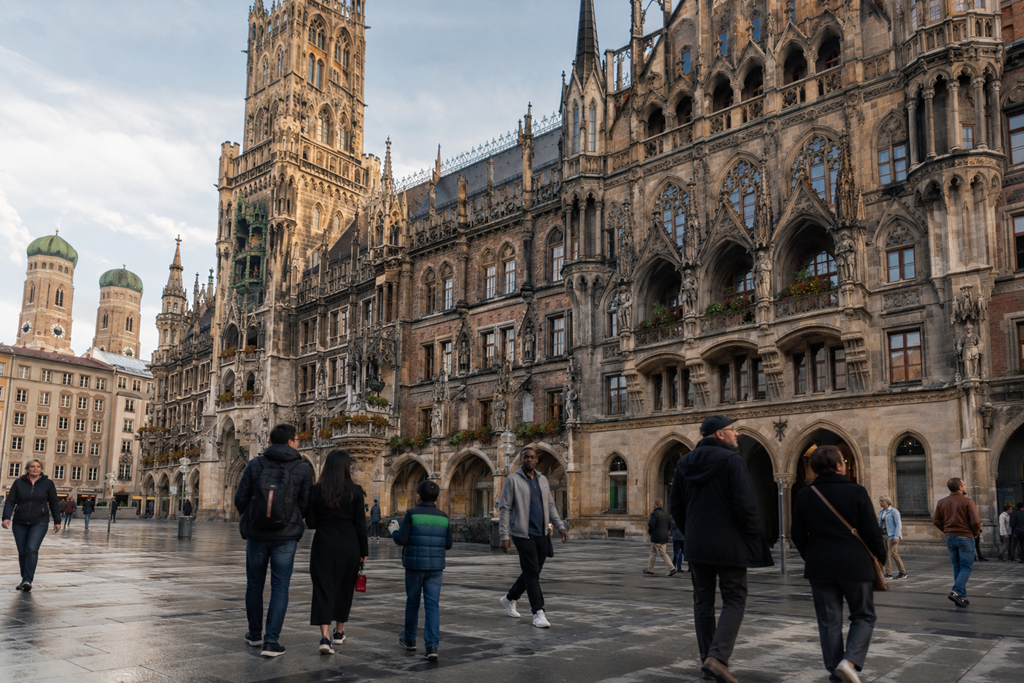
Marienplatz is the natural starting point for a first visit to Munich. This central square has been a gathering place for centuries and puts you close to many of the city’s most recognizable landmarks.
The main visual centerpiece is the New Town Hall, with its detailed Gothic Revival facade and famous Glockenspiel. Even if you do not plan your day around the performance, the square is still worth visiting for the architecture, street activity, and easy access to nearby churches, shops, and walking streets.
For first-time visitors, Marienplatz helps you get oriented quickly. From here, you can walk to Viktualienmarkt, Frauenkirche, St. Peter’s Church, Asamkirche, and several traditional beer halls without needing complicated transportation.
Best for: First-time orientation, architecture, classic Munich photos, and easy walking.
Helpful planning note: Visit early in the day if you want a quieter look at the square. It becomes much busier as the day goes on, especially during popular travel periods.
2)) Visit Viktualienmarkt for Local Food and Everyday Atmosphere
A short walk from Marienplatz, Viktualienmarkt is Munich’s best-known food market and one of the easiest ways to experience local flavor without needing a formal restaurant meal. Munich’s official tourism site describes it as a historic open-air market in the old town with fresh foods, local delicacies, and a lively atmosphere.
You can browse stalls selling produce, cheese, baked goods, flowers, prepared foods, and Bavarian specialties. It is a good place to pause between sightseeing stops, pick up a snack, or simply watch the city move at a more everyday pace.
This is not just a food stop. It also gives you a practical feel for Munich’s blend of tradition and daily life. Even if you only walk through for 20 minutes, it adds texture to your visit.
Best for: Food lovers, casual lunches, local atmosphere, and travelers who enjoy markets.
Helpful planning note: Go hungry, but keep your expectations flexible. Market hours and individual vendors can vary, so check current details before planning your day around a specific stall.
3)) Step Inside Frauenkirche
Frauenkirche, also known as the Cathedral of Our Lady, is one of Munich’s most recognizable landmarks thanks to its two domed towers. You will see it from many parts of the Old Town, and it is worth taking time to step inside rather than only viewing it from the outside.
The interior is spacious and understated compared with some of Munich’s more ornate churches. That contrast makes it especially interesting if you also plan to visit Asamkirche, which is much smaller and more decorative.
For first-time visitors, Frauenkirche is useful as both a landmark and a cultural stop. It gives you a sense of Munich’s religious and architectural history without requiring a long visit.
Best for: Architecture, history, quiet moments, and classic Munich sightseeing.
Helpful planning note: Churches are active places of worship, so visit respectfully and check for service times if you want to tour the interior.
4)) See the View From St. Peter’s Church
For one of the best views over central Munich, consider climbing the tower at St. Peter’s Church. The church itself is one of the oldest in the city, and the tower view gives you a clear perspective over Marienplatz, the New Town Hall, Frauenkirche, and the surrounding rooftops.
This is especially helpful early in your trip because it makes the Old Town easier to understand. You can see how compact the historic center is and how many major sights are within walking distance.
The climb is best for visitors who are comfortable with stairs and tighter spaces. If that does not sound appealing, you can still visit the church interior and enjoy the surrounding area.
Best for: City views, photography, orientation, and active travelers.
Helpful planning note: Visibility matters. If the weather is gray or hazy, the view may be less impressive, so choose a clearer part of your trip if possible.
5)) Admire the Detail Inside Asamkirche
Asamkirche is one of Munich’s most memorable small churches. Tucked along Sendlinger Strasse, it can be easy to miss from the outside, but the interior is richly decorated and dramatic.
Munich’s official guide describes Asamkirche as one of southern Germany’s significant late Baroque buildings. The space is compact, so it does not take long to visit, but the detail rewards slow looking.
This is a strong addition to an Old Town walk because it offers something different from the larger civic squares and more spacious churches. It is also a good reminder that some of Munich’s best experiences are not always the biggest ones.
Best for: Art, architecture, short cultural stops, and travelers who like hidden-in-plain-sight places.
Helpful planning note: Because the church is small, avoid loud conversation and be mindful of other visitors.
Experience Munich’s Museums, Palaces, and Culture
6)) Tour the Munich Residenz
The Munich Residenz is one of the city’s most important cultural sights. Once the seat of Bavarian rulers, it is a large palace complex filled with ornate rooms, courtyards, historic collections, and decorative art.
This is a good choice if you want a deeper look at Munich beyond the Old Town streets. The Residenz helps explain the city’s royal and political history, and the scale of the complex can be surprising if you are expecting only a simple palace visit.
Because there is a lot to see, it is best not to squeeze the Residenz into a rushed gap between other activities. Give yourself enough time to move through the rooms at a steady pace.
Best for: History lovers, palace interiors, decorative arts, and rainy-day sightseeing.
Helpful planning note: Some sections or entry requirements may change, so check current visitor details before you go.
7)) Spend Time at the Deutsches Museum
The Deutsches Museum is one of Munich’s strongest museum choices for first-time visitors, especially if you enjoy science, technology, engineering, or hands-on exhibits. The museum’s official site describes the Museumsinsel location as a place to experience science up close through exhibits, experiments, and interactive stations.
It is a particularly good option for families, curious travelers, and anyone who wants a break from churches and palaces. Exhibits can cover subjects such as aviation, energy, astronomy, health, physics, and transportation, depending on the areas you visit.
Because the museum is large, it helps to choose a few sections that interest you most instead of trying to see everything. A focused visit will usually be more enjoyable than an exhausted one.
Best for: Families, science fans, rainy days, and travelers who like interactive museums.
Helpful planning note: Check current exhibition areas before visiting, since large museums sometimes renovate or rotate sections.
8)) Visit the Kunstareal Museum District
Munich’s Kunstareal is a museum district that brings together major art museums, galleries, universities, and cultural institutions. Munich’s official tourism site describes the area as home to numerous museums and exhibition centers, galleries, universities, and cultural institutions.
For first-time visitors, the best approach is to choose one or two museums rather than trying to cover the entire district. The Alte Pinakothek is known for European old masters, while the Pinakothek der Moderne focuses on modern art, design, architecture, and works on paper.
Even if you are not a serious art traveler, this area is worth considering because it offers a quieter, more spacious counterpoint to the Old Town.
Best for: Art lovers, museum days, design interest, and slower-paced sightseeing.
Helpful planning note: Museum schedules can vary by day, and some museums may close on certain weekdays. Verify current hours before choosing your museum day.
9)) Walk Through Nymphenburg Palace and Park
Nymphenburg Palace is one of the best things to do in Munich when you want beauty, space, and history in one visit. The palace complex includes grand architecture, formal rooms, gardens, water features, and a large park that invites slower exploration.
Munich’s official tourism site recommends strolling through Nymphenburg Palace Park as one of the city’s classic attractions. The official palace site also provides visitor information for the palace and park, including accessibility-related planning details.
This is a strong choice if you have more than one day in Munich. It takes you beyond the tight Old Town and shows a more expansive side of the city.
Best for: Palace lovers, gardens, photography, relaxed walks, and travelers with extra time.
Helpful planning note: The park is a major part of the experience. Wear comfortable shoes and allow time to enjoy the grounds, not just the palace interiors.
Enjoy Munich’s Parks, Neighborhoods, and Local Rhythm
10)) Wander the Englischer Garten
The Englischer Garten is one of Munich’s defining green spaces and a refreshing break from museums and historic buildings. It is large, leafy, and ideal for walking, cycling, sitting by the water, or simply watching local life unfold.
One of the most famous sights near the park is the Eisbach wave, where river surfers have long drawn spectators. Munich’s official tourism site identifies the Eisbachwelle as a well-known city-center river surfing spot and a popular attraction for visitors. Because access and safety rules can change, treat it as something to check locally rather than something to build your entire day around.
The park itself is the main reason to go. It gives Munich a relaxed, livable feeling and works well after a morning of dense sightseeing.
Best for: Walking, fresh air, casual sightseeing, and balancing a busy itinerary.
Helpful planning note: The park is large, so choose a general area before you go. You do not need to see all of it for the visit to be worthwhile.
11)) Explore Olympiapark and BMW Welt
Olympiapark offers a different side of Munich: modern architecture, open space, sports history, and sweeping views. Built for the 1972 Summer Olympics, the area remains one of the city’s most distinctive modern landscapes.
Nearby BMW Welt and the BMW Museum appeal to visitors interested in cars, design, engineering, or contemporary architecture. BMW Welt’s official site notes that visitors can explore vehicles in the showroom, while the wider complex includes museum and brand experiences.
This area is especially useful if you want to break up a trip focused heavily on Old Town history. It pairs well as a half-day outing and can also work on a cloudy day.
Best for: Modern architecture, car enthusiasts, families, sports history, and wider city exploration.
Helpful planning note: Check current details for BMW Museum and BMW Welt before visiting, especially if a particular exhibition, tour, or experience matters to you.
12)) Take a Respectful Day Trip to Dachau Concentration Camp Memorial Site
The Dachau Concentration Camp Memorial Site is not a light sightseeing stop, but it is one of the most historically important places near Munich. For many visitors, it offers essential context for understanding Germany’s 20th-century history.
The official memorial site explains that today’s memorial is a place of remembrance for the people who suffered in Dachau concentration camp and for the tens of thousands who died there. Munich’s official tourism site notes that visitors can tour the former camp grounds, buildings, and permanent exhibition, with guided tours and audio guides available.
If you go, approach the visit with care. This is a memorial and a place of mourning, not a typical attraction. Give yourself enough time and emotional space, and avoid pairing it with an overly packed day.
Best for: History-focused travelers, reflective visits, and those who want deeper context beyond central Munich.
Helpful planning note: Review current visitor guidelines before going and consider a guided tour or audio guide for better historical understanding.
How to Prioritize Your First Munich Trip
If you only have one day in Munich, focus on the Old Town: Marienplatz, Viktualienmarkt, Frauenkirche, St. Peter’s Church, Asamkirche, and perhaps the Residenz if you enjoy palace interiors.
With two days, add the Englischer Garten and either the Deutsches Museum or the Kunstareal, depending on your interests.
With three or more days, include Nymphenburg Palace, Olympiapark and BMW Welt, or a respectful day trip to Dachau. This gives you a better balance of historic Munich, cultural Munich, green Munich, and modern Munich.
Munich is easy to enjoy when you do not overload your schedule. Choose a few strong experiences each day, leave time for walking and meals, and check current opening hours or reservation requirements before visiting major attractions.
Download Our Free E-book!