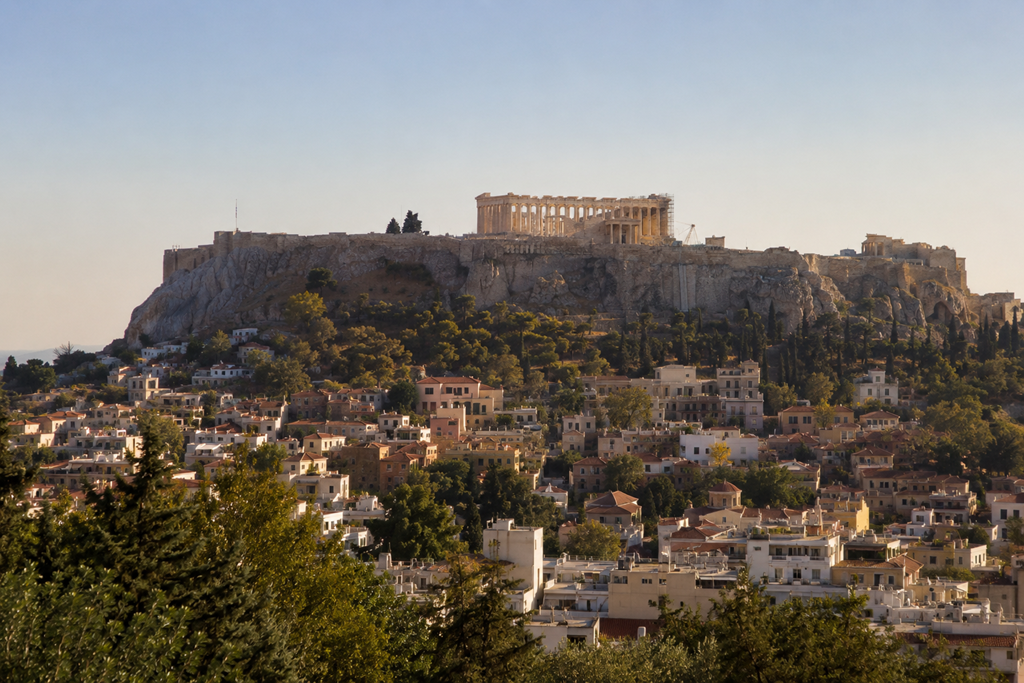
Athens is one of the best cities in Europe for travelers who want history, culture, food, and walkable neighborhoods in one trip. The city can feel layered at first: ancient temples sit above busy streets, quiet churches appear between shops, and rooftop views often include both modern apartments and the Acropolis.
This guide focuses on the best things to do in Athens for a first-time or return visit. You’ll find major archaeological sites, museums, neighborhoods, scenic walks, food experiences, and practical ideas that are likely to stay useful well beyond a single travel season.
Ancient Athens And Essential Historic Sites
1)) Visit the Acropolis
The Acropolis is the defining landmark of Athens and one of the most important ancient sites in the world. UNESCO describes it as the most complete ancient Greek monumental complex still existing today, set on a rocky hill above the city.
The main reason to go is the combination of architecture, history, and setting. You are not just looking at one monument; you are walking through a hilltop complex that includes the Parthenon, the Erechtheion, the Propylaea, and other remains tied to ancient Athenian life.
For the best experience, visit early or later in the day when possible, wear comfortable shoes, and bring water. The paths can be uneven, and much of the site is exposed to sun and wind. Check current opening hours and reservation rules before you go.
2)) See the Parthenon Up Close
The Parthenon is the most famous structure on the Acropolis and one of the strongest symbols of ancient Greece. Even if you have seen it in photos, standing near it gives you a better sense of its scale, placement, and visual balance.
It is worth slowing down here instead of treating it as a quick photo stop. Walk around the site, look at how the temple sits against the skyline, and notice how it changes depending on the light and angle.
This is best for travelers who want the classic Athens experience, but it is also meaningful for anyone interested in architecture, mythology, art history, or Western cultural heritage.
3)) Explore the Acropolis Museum
The Acropolis Museum helps make sense of what you saw on the hill. The museum focuses on findings from the Acropolis archaeological site, with exhibits that trace the history of the area from ancient times through later periods.
One of its most memorable spaces is the Parthenon Gallery, designed to display sculptures and architectural elements in visual conversation with the Parthenon itself. The museum also incorporates remains of an ancient neighborhood into its design, giving visitors another layer of context.
If you are deciding whether to visit before or after the Acropolis, either can work. Visiting after the Acropolis often helps the exhibits feel more connected to the real site.
4)) Walk Through the Ancient Agora
The Ancient Agora was once the civic and social heart of Athens. It is where public life, trade, politics, and philosophy intersected in the ancient city.
Today, it is a spacious archaeological area with ruins, trees, walking paths, and views toward the Acropolis. It is less compressed than the Acropolis, which makes it easier to wander slowly.
This is a good choice if you want a deeper understanding of daily life in ancient Athens rather than only seeing its ceremonial monuments. Give yourself time to walk the grounds and visit the museum inside the reconstructed Stoa of Attalos.
5)) Visit the Temple of Olympian Zeus
The Temple of Olympian Zeus is a striking ancient site near central Athens. Although much of the temple is gone, the remaining columns still give a strong impression of its former scale.
It pairs well with nearby attractions such as Hadrian’s Arch, the National Garden, and the Panathenaic Stadium. If your time is limited, this can be a shorter stop, but it is worth seeing for the sense of grandeur it adds to the city’s ancient landscape.
6)) Stop at the Roman Agora
The Roman Agora offers another look at Athens after the classical Greek period. It is smaller than the Ancient Agora but still valuable, especially because it shows how the city continued to evolve under Roman influence.
The Tower of the Winds is one of the standout features here. This site is especially easy to include while exploring Plaka, Monastiraki, or the historic center on foot.
7)) See the Panathenaic Stadium
The Panathenaic Stadium is one of Athens’ most distinctive landmarks. Built in marble and shaped into a long horseshoe, it connects ancient athletic traditions with the modern Olympic story.
It is easy to visit from central Athens and works well as part of a walk that includes the National Garden, Syntagma, and nearby neighborhoods. Even a short visit gives you a strong visual contrast to the city’s temples and museums.
Museums, Culture, And Local History
8)) Spend Time at the National Archaeological Museum
The National Archaeological Museum is one of the best places in Athens to understand the broader story of ancient Greece. While the Acropolis Museum focuses on one major site, this museum gives you a wider view of Greek archaeology, sculpture, pottery, metalwork, and ancient art.
It is best for travelers who enjoy museums and want more depth than a single landmark can provide. Because the collection is large, it helps to choose a few areas of interest rather than trying to see everything at the same pace.
9)) Visit the Benaki Museum
The Benaki Museum is a strong choice if you want Greek history beyond the ancient world. Its collections help connect different periods of Greek culture, including Byzantine, Ottoman, and modern influences.
This museum is especially useful for travelers who want a more rounded sense of Athens and Greece. It pairs well with a visit to Kolonaki or a walk near Syntagma.
10)) Watch the Changing of the Guard at Syntagma Square
Syntagma Square is one of the main civic spaces in Athens. In front of the Hellenic Parliament, visitors gather to watch the ceremonial changing of the guard.
It is a short, easy experience to include in a day of sightseeing. The appeal is not that it takes long, but that it places you in the center of modern Athens, where government buildings, public transit, hotels, shops, and everyday city life come together.
11)) Step Inside a Historic Church
Athens has many small historic churches tucked between shops, squares, and busy streets. These churches are easy to miss if you focus only on major archaeological sites, but they add important texture to the city.
Look for Byzantine churches while walking through areas such as Plaka, Monastiraki, and the historic center. You do not need to plan a full itinerary around them; simply stepping inside one or two can offer a quiet pause and a different view of Athens’ long religious and architectural history.
Neighborhoods And Walkable Areas
12)) Wander Through Plaka
Plaka is one of Athens’ most famous neighborhoods and a natural area for first-time visitors. The official Athens guide describes it as a top attraction known for picturesque streets, historic landmarks, lively shops, and crowds.
The best way to experience Plaka is without rushing. Walk the side streets, look for small squares, notice the older homes, and take breaks when the area feels busy. It is touristy in places, but it is still worth visiting because of its location, atmosphere, and connection to the city’s historic core.
13)) Explore Monastiraki
Monastiraki is one of the most energetic parts of central Athens. The official city guide describes it as a place where layers of history meet commerce and craftsmanship.
This is a good area for browsing, people-watching, casual meals, and views of the Acropolis from surrounding streets and rooftops. It is also a useful base for walking to the Ancient Agora, Roman Agora, Plaka, and Psiri.
Monastiraki is best approached with flexibility. Some streets feel busy and commercial, while others quickly lead into older corners of the city.
14)) Walk Anafiotika
Anafiotika is a small hillside area tucked below the Acropolis, known for whitewashed houses, narrow lanes, and a village-like feel. It is one of the most atmospheric walks in Athens, especially if you enjoy quiet corners and photography.
Because the area is residential, visit respectfully. Keep noise low, avoid blocking doorways, and treat it as a living neighborhood rather than a staged attraction.
15)) Spend an Evening in Psiri
Psiri is a lively neighborhood known for casual dining, bars, street art, and evening atmosphere. It is a good place to experience Athens after a day of museums and ruins.
The main reason to go is the contrast. Athens is not only ancient sites; it is also a social, creative, lived-in city. Psiri works well for travelers who want dinner, drinks, music, or a relaxed stroll through a more energetic part of town.
16)) Visit Kolonaki
Kolonaki offers a different side of Athens. It is known for polished streets, boutiques, cafes, galleries, and proximity to museums and Lycabettus Hill.
This area is best if you want a slower break from the busiest sightseeing zones. It is also useful for travelers who enjoy cafe culture, design, shopping, and neighborhood wandering without needing every stop to be a major landmark.
Viewpoints, Parks, And Outdoor Experiences
17)) Climb or Ride Up Lycabettus Hill
Lycabettus Hill is one of the best viewpoints in Athens. From the top, you can see the Acropolis, the city grid, surrounding hills, and, on clear days, the coastline.
You can walk up if you are comfortable with a climb, or use available transport options depending on current conditions. Sunset is popular, but it can also be crowded. For a quieter visit, consider going earlier in the day or choosing a less obvious time.
This is one of the best things to do in Athens if you want to understand the city’s geography.
18)) Walk the Pedestrian Route Around the Acropolis
The pedestrian streets around the Acropolis create one of the most pleasant walks in central Athens. This route connects major sites, neighborhoods, cafes, performers, and viewpoints without requiring constant traffic crossings.
It is especially helpful for first-time visitors because it links several important areas naturally. You can walk between the Acropolis Museum, the Acropolis entrances, the Ancient Agora area, and nearby neighborhoods while keeping the Acropolis in view for much of the route.
19)) Take a Break in the National Garden
The National Garden is a useful reset in the middle of Athens. Located near Syntagma and the Hellenic Parliament, it provides shade, walking paths, and a slower pace close to major sightseeing areas.
It is not the city’s most dramatic attraction, but that is part of its value. Use it as a practical break between museums, monuments, and busy streets, especially during warmer parts of the day.
20)) Watch Sunset From Philopappos Hill
Philopappos Hill offers one of the most rewarding views of the Acropolis. It is less formal than a museum or archaeological site and works well as a scenic walk, especially in the late afternoon.
The paths can be uneven, so comfortable shoes are helpful. Bring water, allow enough daylight for the walk, and be aware of your surroundings as you would in any urban park.
This is a strong final stop for travelers who want a memorable view without needing another ticketed attraction.
Food And Everyday Athens Experiences
Athens is a good city for simple, satisfying food experiences. Rather than chasing trendy restaurants, focus on durable local staples: Greek coffee, fresh bread, souvlaki, pies, grilled meats, seafood, yogurt, olives, cheeses, and seasonal produce.
Markets, bakeries, tavernas, and neighborhood cafes can all be part of the experience. For a practical food-focused day, combine a morning coffee, a central market walk, a casual lunch, and dinner in a neighborhood like Psiri, Koukaki, Plaka, or Pangrati.
How To Prioritize Your Time In Athens
If you only have one day, focus on the Acropolis, Acropolis Museum, Plaka, Monastiraki, and one viewpoint.
With two or three days, add the Ancient Agora, National Archaeological Museum, Syntagma, the National Garden, Psiri, and Lycabettus or Philopappos Hill.
With more time, slow down. Athens becomes more rewarding when you leave room for neighborhood walks, cafe breaks, smaller museums, churches, markets, and unplanned views of the Acropolis between buildings.
Practical Notes For Visiting Athens
Athens is very walkable in the historic center, but the city is larger than it first appears. Choose your base carefully if you want to minimize transit time. Plaka, Monastiraki, Koukaki, Syntagma, and nearby areas are convenient for first-time visitors.
Summer can be hot, and many major sites have limited shade. Plan exposed archaeological sites for earlier or later in the day when possible, and use museums, shaded gardens, and meals as breaks during warmer hours. In very hot conditions, outdoor sites may adjust access for safety, so checking current details before visiting is wise.
For popular attractions such as the Acropolis, timed-entry or advance booking rules may apply, so verify current requirements before finalizing your plans.
A Thoughtful Way To Experience Athens
The best way to experience Athens is not to treat it as a checklist of ruins. The ancient sites matter, but so do the neighborhoods, museums, food, viewpoints, and ordinary streets between them.
Give the Acropolis the attention it deserves, then let the rest of the city fill in the picture. Athens is most rewarding when you balance history with daily life: a museum in the morning, a shaded walk in the afternoon, a neighborhood dinner in the evening, and a view of the Acropolis when the city lights begin to come on.
Download Our Free E-book!