Los Angeles can feel enormous when you first start planning a trip. The city stretches across beaches, hills, museums, movie landmarks, shopping districts, food neighborhoods, and scenic drives, which makes it easy to overpack your itinerary.
This guide focuses on classic, worthwhile things to do in Los Angeles that are likely to remain useful for first-time and return visitors. You’ll find beaches, cultural attractions, neighborhoods, viewpoints, food experiences, and practical planning notes to help you decide what belongs on your trip.
Beaches, Ocean Views, And Outdoor Classics
1)) Spend time at Santa Monica Pier and Beach
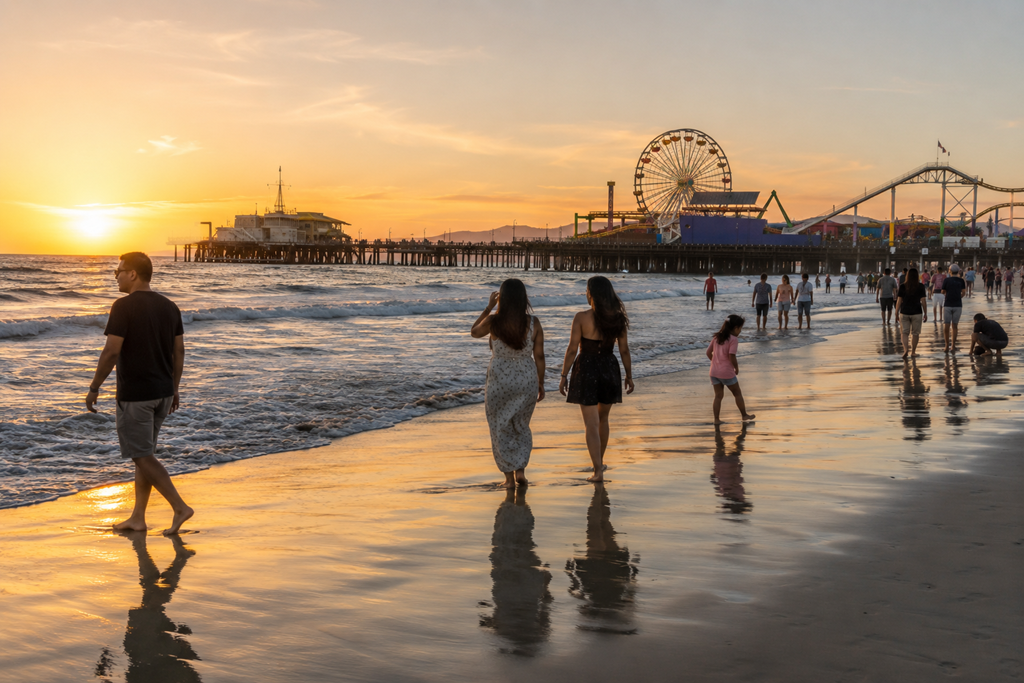
Santa Monica is one of the easiest beach areas to recommend for a first Los Angeles trip. You get a wide beach, ocean views, bike paths, restaurants, shops, and the historic pier in one walkable area.
The pier is especially useful if you want a classic coastal L.A. experience without needing to plan every minute. Pacific Park, the amusement area on the pier, includes rides, games, food, and the well-known Pacific Wheel, while the pier itself is also a good place for a sunset walk or casual people-watching.
Santa Monica works well for families, couples, solo travelers, and anyone who wants a simple beach day with plenty nearby.
2)) Walk the Venice Beach Boardwalk
Venice Beach is more energetic and unpredictable than Santa Monica. The Ocean Front Walk is known for street performers, artists, vendors, shops, skaters, outdoor fitness areas, and constant people-watching. Los Angeles Recreation and Parks describes Venice Beach as one of the city’s busiest recreation facilities, and Discover Los Angeles highlights the boardwalk as one of the best places in L.A. for people-watching.
Go during the day, keep your belongings close, and treat it as an observational walk rather than a quiet beach escape. It is best for travelers who enjoy local color, street culture, and a lively waterfront atmosphere.
3)) Bike or walk between Santa Monica and Venice
One of the simplest ways to enjoy the coast is to connect Santa Monica and Venice by foot or bike. The beach path lets you experience both areas without needing to move your car or arrange another ride.
This is a good option if you want ocean air, casual exercise, and flexibility. Start in Santa Monica for a more polished beach setting, continue toward Venice for a more eclectic atmosphere, and turn around whenever you’ve had enough.
For most travelers, this works better as a half-day experience than a rushed stop.
4)) Watch the sunset from the coast
Los Angeles sunsets are one of the city’s most reliable travel pleasures. Santa Monica, Venice, Manhattan Beach, El Matador State Beach, and parts of Malibu can all offer memorable evening views, depending on where you are staying.
The best sunset plan is usually the simplest one: choose a beach area that fits your day’s geography, arrive early enough to park or walk comfortably, and avoid trying to cross the city at the last minute.
If your trip is short, pair sunset with Santa Monica Pier, Venice, or a Malibu drive so the evening feels connected rather than rushed.
5)) Take a scenic drive along the Pacific Coast Highway
A drive along the coast is one of the most recognizable Southern California experiences. From the Westside, you can head toward Malibu for ocean views, beach stops, and a slower pace than central Los Angeles.
This is best for visitors who have access to a car and are comfortable with L.A.-area traffic. Keep the plan flexible: choose one or two beach stops rather than trying to see everything in one afternoon.
A coastal drive is especially worthwhile if your trip has been focused on museums, Hollywood, or Downtown L.A. It gives you a different view of the region.
Views, Parks, And Iconic Los Angeles Sights
6)) Visit Griffith Observatory
Griffith Observatory is one of the best places to understand the scale of Los Angeles. Set within Griffith Park, it offers city views, views toward the Hollywood Sign, astronomy exhibits, telescopes, and planetarium programming. The observatory’s official site describes it as a public gateway to space and a place to see exhibits, live shows, telescopes, and broad views of Los Angeles.
It is worth visiting even if you do not go inside every exhibit. The terrace views alone make it one of the most rewarding stops in the city.
Check current hours before you go, and expect parking and traffic around the observatory to be more challenging during popular times.
7)) Hike in Griffith Park
Griffith Park is one of the most useful outdoor areas for visitors because it combines hiking, views, and proximity to Hollywood and Los Feliz. You can choose a short walk, a longer trail, or a route that gives you views of the Hollywood Sign.
This is best for travelers who want an active break from driving and sightseeing. Bring water, sun protection, and shoes suitable for dusty trails.
If you only have time for one outdoor viewpoint in Los Angeles, Griffith Park and Griffith Observatory are strong choices because they combine nature, city views, and a classic L.A. landmark.
8)) See the Hollywood Sign from a practical viewpoint
The Hollywood Sign is more enjoyable when you plan for a good viewpoint instead of trying to get too close. Griffith Observatory, Lake Hollywood Park, and some Griffith Park trails are common options for seeing or photographing it.
The sign itself sits in a residential and hillside area, so avoid routes that create parking problems or send you into restricted areas. For most visitors, a clear view from a public spot is more satisfying than spending too much time chasing the closest possible angle.
Pair this with Griffith Observatory or a Hollywood visit to keep your day efficient.
9)) Walk along Hollywood Boulevard, briefly and selectively
Hollywood Boulevard is famous, but it is not always the most relaxing part of Los Angeles. The Walk of Fame, TCL Chinese Theatre, and nearby entertainment landmarks can be worth seeing if movie history is part of your trip.
The best way to approach Hollywood Boulevard is with realistic expectations. Go for the classic landmarks, take your photos, and then move on to another nearby area such as Griffith Observatory, Los Feliz, West Hollywood, or the Hollywood Hills.
It is best as a short stop, not the centerpiece of a full day.
10)) Explore Runyon Canyon or another urban hiking spot
Runyon Canyon is popular because it gives you a quick urban hike with city views close to Hollywood and West Hollywood. It is a good fit if you want exercise without leaving central L.A.
Expect crowds, exposed sun, and limited shade. If you prefer a quieter hike, Griffith Park may be a better choice.
For visitors staying near Hollywood, West Hollywood, or Beverly Grove, Runyon can be an easy morning activity before museums, shopping, or lunch.
Museums, Art, And Culture
11)) Spend a few hours at the Getty Center
The Getty Center is one of Los Angeles’ strongest all-around cultural attractions. It combines art, architecture, gardens, city views, and a hilltop setting in Brentwood. The Getty describes the center as featuring art from the Middle Ages to today, modern architecture, and gardens, while also noting that the Getty has two Los Angeles locations: the Getty Center and the Getty Villa.
This is a good choice even for travelers who do not usually build trips around museums, because the setting is part of the experience.
Check current reservation, parking, and transportation details before visiting, especially during busy travel periods.
12)) Visit the Getty Villa
The Getty Villa, located along the coast north of Santa Monica, focuses on ancient Greek and Roman art in a setting inspired by a Roman villa. The Getty notes that the Villa displays ancient Greek and Roman art in a recreated Roman house near the coast.
It is best for travelers interested in history, classical art, architecture, gardens, or a quieter cultural experience near the beach.
Because the Villa is not in the same part of the city as the Getty Center, avoid trying to squeeze both Getty locations into a rushed itinerary unless you have a specific reason.
13)) See contemporary art at The Broad
The Broad is a major contemporary art museum in Downtown Los Angeles. Its official visitor information notes that general admission is free and that reserving a timed ticket in advance is recommended, with some exhibitions and events requiring a separate charge.
This is a strong choice if you are spending time downtown, especially because it pairs well with Walt Disney Concert Hall, Grand Park, the Arts District, Little Tokyo, or Grand Central Market.
If your trip includes only one downtown museum, The Broad is one of the easiest to fit into a half-day plan.
14)) Visit LACMA and Museum Row
The Los Angeles County Museum of Art sits along Museum Row in the Miracle Mile area. Discover Los Angeles describes LACMA as the largest art museum in the western United States, with a collection spanning thousands of years of artistic expression.
Even if you do not tour the full museum, the area is useful for visitors because it places several attractions close together, including LACMA, the La Brea Tar Pits, the Academy Museum, and other nearby cultural stops.
Reserve or check ticket details ahead of time, since museum admission policies and gallery access can change.
15)) Visit the Academy Museum of Motion Pictures
Los Angeles is deeply tied to film history, and the Academy Museum is one of the most direct ways to explore that connection. It is especially worthwhile for movie fans, families with older children, and travelers who want a polished museum experience rooted in the city’s entertainment identity.
The museum is located near LACMA and the La Brea Tar Pits, making it easy to build a Museum Row day instead of crossing the city repeatedly.
Give yourself enough time to enjoy the exhibits without rushing, and check current ticketing details before you go.
Neighborhoods, Food, And Local Flavor
16)) Eat your way through Grand Central Market
Grand Central Market is one of the most useful food stops in Downtown Los Angeles because it gives you variety in one historic indoor market setting. It works well for groups because everyone can choose something different without needing a formal restaurant reservation.
Pair it with The Broad, Angels Flight, Walt Disney Concert Hall, the Bradbury Building, Little Tokyo, or a downtown walking route.
This is a good lunch stop when you want something casual, flexible, and strongly tied to the city’s food culture.
17)) Explore Little Tokyo
Little Tokyo is one of the most rewarding neighborhoods to visit downtown. It offers Japanese restaurants, sweets, shops, cultural landmarks, and easy access to nearby areas like the Arts District and the Civic Center.
It is best experienced slowly. Walk the plazas, browse shops, stop for ramen, sushi, mochi, or matcha, and give yourself time to notice the neighborhood rather than treating it as only a meal stop.
Little Tokyo works especially well as part of a downtown day with The Broad, Grand Central Market, or the Arts District.
18)) Walk through the Arts District
The Arts District gives visitors a different side of Los Angeles: warehouses, murals, design shops, coffee spots, galleries, restaurants, and a creative industrial feel. It is a good choice if you like neighborhoods that are better explored on foot than through a single attraction.
Because the area changes over time, avoid planning around one trendy venue. Instead, use it as a neighborhood walk with flexible stops.
It pairs naturally with Little Tokyo, the Los Angeles River area, or a downtown food stop.
19)) Visit Beverly Hills and Rodeo Drive
Beverly Hills is worth visiting if you want polished streets, luxury window-shopping, palm-lined boulevards, and classic Los Angeles scenery. Rodeo Drive is the most famous stop, but the surrounding streets are often just as enjoyable for a relaxed walk.
This does not need to be a long visit. For many travelers, an hour or two is enough to walk, take photos, get coffee, and continue to West Hollywood, Museum Row, or the beach.
It is best for travelers who enjoy architecture, shopping districts, and iconic city imagery.
20)) Spend time in Los Feliz or Silver Lake
Los Feliz and Silver Lake offer a more neighborhood-based L.A. experience than the major tourist corridors. You’ll find independent shops, cafes, restaurants, bookstores, hillside streets, and easy access to Griffith Park.
These areas are especially useful if you want to balance major attractions with everyday local atmosphere. Start with a meal or coffee, browse a few shops, and then connect the visit with Griffith Observatory or a park walk.
For a trip that feels less rushed, adding one neighborhood like this can make Los Angeles feel more understandable.
How To Plan Your Los Angeles Sightseeing Without Overdoing It
Los Angeles rewards focused planning. The biggest mistake is treating the city like a compact destination where you can jump quickly between every famous attraction.
A better approach is to group your days by geography:
- Westside and coast: Santa Monica, Venice, Malibu, Getty Villa
- Hollywood and Griffith Park: Hollywood Boulevard, Griffith Observatory, Griffith Park, Los Feliz
- Museum Row and Beverly Hills: LACMA, Academy Museum, La Brea Tar Pits, Beverly Hills
- Downtown L.A.: The Broad, Grand Central Market, Little Tokyo, Arts District, Union Station
Public transit can help in some areas, especially downtown and along certain Metro routes. Metro provides a trip planner with real-time details for bus and rail trips, which is useful when deciding whether transit or rideshare makes more sense for a specific day.
If you rent a car, build in time for traffic, parking, and slower cross-town travel. If you do not rent a car, choose accommodations near the areas you care about most and use a mix of walking, transit, and rideshare.
Los Angeles is easier to enjoy when you do fewer things well.
Download Our Free E-book!