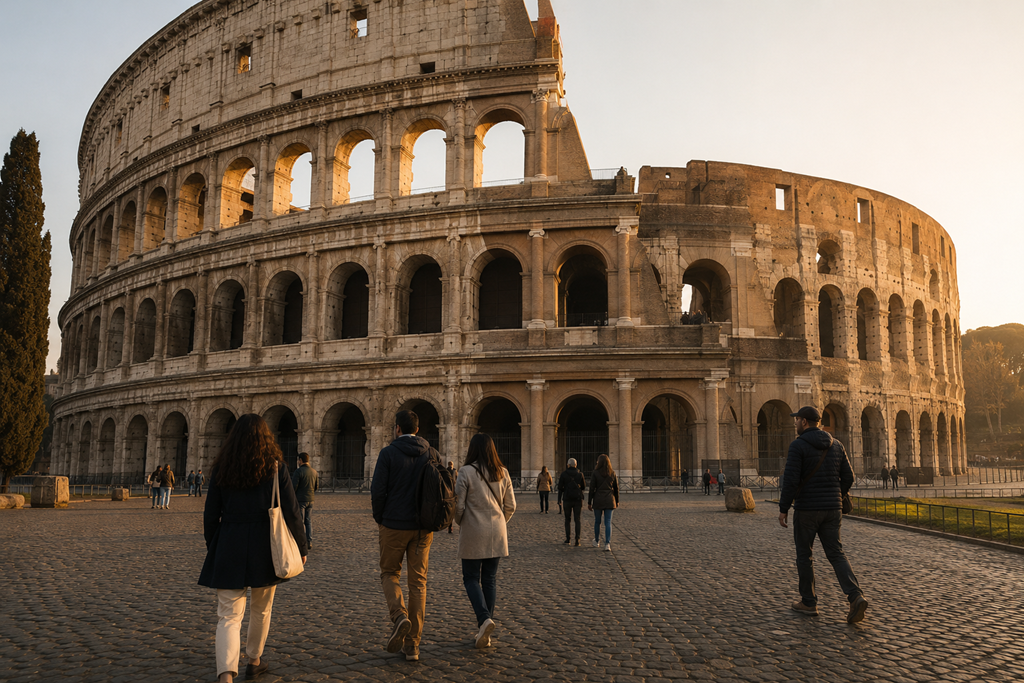
Rome is one of those cities where the main sights really are worth seeing—but the best trip usually comes from balancing the famous landmarks with slower, more local-feeling experiences. This guide covers 20 of the best things to do in Rome, from ancient ruins and major museums to neighborhoods, viewpoints, markets, and quieter corners that help the city feel less overwhelming.
Rome rewards travelers who plan a little, walk a lot, and leave room for unplanned moments. Some major attractions may require timed-entry reservations, and hours or access rules can change, so check current details before you go—especially for the Colosseum, Vatican Museums, and popular galleries. Rome’s official tourism site highlights the Colosseum, Pantheon, Roman Forum and Palatine Hill, Trevi Fountain, Piazza Navona, Villa Borghese, Orange Garden, Pincio, and Janiculum Hill among the city’s major visitor experiences.
Ancient Rome And Historic Landmarks
1)) Visit the Colosseum
The Colosseum is one of Rome’s most recognizable landmarks and a strong place to start if this is your first visit. Officially known as the Flavian Amphitheatre, it was built in the 1st century CE and once hosted public spectacles including gladiatorial games and animal hunts.
It is worth visiting not just for the size of the structure, but for the way it helps you understand ancient Rome as a public, political, and social world. The exterior is impressive on its own, but going inside gives you a better sense of the arena, seating levels, and scale.
For most travelers, the best approach is to book ahead, arrive early or later in the day, and pair it with the Roman Forum and Palatine Hill rather than treating it as a quick photo stop.
2)) Walk Through the Roman Forum
The Roman Forum was the center of ancient civic life, where politics, religion, commerce, and public gatherings shaped the city. Today it feels like an open-air museum, with ruins of temples, arches, basilicas, and ancient roads spread across a large archaeological area.
This is best for travelers who enjoy history, ruins, and slow wandering. It can be harder to interpret than the Colosseum, so a guide, audio guide, or self-guided map can make the experience much more meaningful.
Give yourself enough time here. The Forum is not a place to rush through between bigger attractions—it is one of the best places in Rome to feel the layers of the city.
3)) Explore Palatine Hill
Palatine Hill sits above the Roman Forum and is traditionally connected with Rome’s earliest origins. It also became one of the most prestigious areas of the ancient city, with imperial residences and wide views over the surrounding ruins.
This is a good activity if you want a quieter ancient Rome experience after the crowds of the Colosseum. The paths, garden-like spaces, and elevated viewpoints make it easier to pause and take in the city’s geography.
Plan to visit the Forum and Palatine Hill together, since they are commonly experienced as part of the same archaeological area. Wear comfortable shoes, bring water, and expect uneven ground.
4)) Step Inside the Pantheon
The Pantheon is one of Rome’s most remarkable ancient buildings. From the outside, it can feel surprisingly compact, tucked into a busy piazza. Inside, the space opens into a vast domed interior with the famous oculus at the center.
The Pantheon is ideal for travelers who want a high-impact stop that does not require hours of museum time. It is also a helpful reminder that Rome is not just ruins—the city’s ancient buildings have often been reused, adapted, and woven into later religious and civic life.
Because access rules can change, check current entry details before visiting. If the piazza is crowded, step away into the surrounding lanes afterward; the area around the Pantheon is excellent for wandering.
Squares, Fountains, And Classic Rome Walks
5)) See Piazza Navona
Piazza Navona is one of Rome’s most elegant public squares, known for its long oval shape, fountains, and Baroque architecture. It is a strong stop for first-time visitors because it combines art, architecture, street life, and easy access to nearby historic lanes.
The square is beautiful at different times of day. Morning can feel more spacious, while evening brings more atmosphere. It is also a natural stop on a walking route that includes the Pantheon, Campo de’ Fiori, and the surrounding centro storico.
Rather than only photographing the fountains and leaving, take a few minutes to notice the shape of the square. Its layout follows the site of an ancient stadium, which is a good example of how Rome’s past remains visible in the modern city.
6)) Visit the Trevi Fountain
The Trevi Fountain is busy for a reason. It is dramatic, detailed, and set into a compact square that makes the reveal feel theatrical when you approach through the side streets.
This is one of the most popular sights in Rome, so expectations matter. It will often be crowded, and that does not necessarily mean it is not worth visiting. The trick is to go with patience, avoid blocking the flow of people, and consider visiting early in the morning or later in the evening.
Treat it as a short but memorable stop, not a major half-day activity. It pairs well with the Spanish Steps and nearby shopping streets.
7)) Climb the Spanish Steps
The Spanish Steps connect Piazza di Spagna with the church of Trinità dei Monti and are one of Rome’s classic gathering places. The experience is less about a single monument and more about the view, the movement of people, and the surrounding streets.
This area is best for travelers who enjoy architecture, window shopping, and elegant urban scenery. It can be very crowded, so it is better as part of a walk than as a destination that needs a long visit.
From here, continue toward the Pincio Terrace or the Trevi Fountain depending on your route. The Spanish Steps are most satisfying when they help connect your day rather than interrupt it.
8)) Take a Self-Guided Walk Through the Centro Storico
Rome’s historic center is made for wandering. Some of the best moments happen between the famous stops: narrow lanes, small churches, weathered doorways, hidden courtyards, and little cafés tucked into side streets.
A simple route could connect Campo de’ Fiori, Piazza Navona, the Pantheon, Trevi Fountain, and the Spanish Steps. This gives you a strong introduction to central Rome without relying only on taxis or public transport.
This is one of the best things to do on your first full day because it helps you understand how close many landmarks are to one another. Keep the pace realistic, stop often, and let the side streets be part of the experience.
Vatican City And Major Art Experiences
9)) Visit the Vatican Museums and Sistine Chapel
The Vatican Museums are one of the major art experiences in Rome and include access to the Sistine Chapel with a standard museum visit. The Vatican Museums note that entry tickets are valid for the Museums and Sistine Chapel on the issued day, and the official site advises travelers to use the official ticket portal to avoid lookalike sellers.
This is best for travelers who are interested in art, religious history, sculpture, frescoes, and grand museum spaces. It can also be tiring, so it helps to know your priorities before you go.
If you mainly want to see the Sistine Chapel, remember that it comes near the end of a broader museum route. Dress requirements may apply in Vatican spaces, and the Vatican Museums advise visitors to dress appropriately for entry.
10)) See St. Peter’s Basilica
St. Peter’s Basilica is one of the most important religious and architectural sites in Rome. Even travelers who are not religious often find it worthwhile for its scale, art, and atmosphere.
The basilica pairs naturally with the Vatican Museums, but doing both on the same day can be a long experience. If you prefer slower travel, consider visiting the basilica separately so you are not rushing through either site.
Expect security lines and dress expectations. Check current access details before you go, especially during major religious periods or special events.
11)) Visit the Borghese Gallery
The Borghese Gallery is one of Rome’s best museum experiences for travelers who want world-class art in a more contained setting than the Vatican Museums. It is especially known for sculpture, painting, and the setting of Villa Borghese.
This is a good choice if you want quality over quantity. The visit is structured and usually requires advance planning, which can actually make it easier to enjoy because the gallery experience feels more focused.
Pair it with a walk through Villa Borghese afterward. The combination of art, gardens, and viewpoints makes this one of Rome’s most balanced half-day plans.
12)) Explore the Capitoline Museums
The Capitoline Museums sit on Capitoline Hill and offer a strong introduction to ancient Roman art, sculpture, and civic history. They are often less overwhelming than the Vatican Museums but still deeply rewarding.
This is a smart pick if you want a museum that connects directly to Rome’s identity. The location is also excellent, with views toward the Roman Forum and easy access to Piazza Venezia.
For history-minded travelers, the Capitoline Museums can help make the ruins feel more understandable. They are especially useful if you want context without committing to a full guided tour.
Neighborhoods, Markets, And Local Culture
13)) Spend Time in Trastevere
Trastevere is one of Rome’s most atmospheric neighborhoods, with cobblestone streets, warm-toned buildings, small piazzas, and a lively evening scene. It is popular, but it still offers a more residential texture than the busiest monument zones.
Go during the day for quieter wandering, churches, and photography, or in the evening for dinner and neighborhood energy. The area works especially well for travelers who want to balance sightseeing with a more relaxed sense of place.
Do not treat Trastevere as only a restaurant district. Walk beyond the busiest lanes, step into smaller side streets, and give yourself time to explore without a fixed checklist.
14)) Browse Campo de’ Fiori
Campo de’ Fiori is a historic square known for its market activity and central location. It is not a hidden gem, but it is useful and atmospheric when visited with the right expectations.
During market hours, it can be a good place to browse produce, flowers, and food-related items, though it is also firmly on the tourist path. Later in the day, the square shifts into a social and dining area.
This is best as part of a broader walk through central Rome. Pair it with Piazza Navona, the Pantheon, or the Jewish Ghetto for an easy, walkable route.
15)) Walk Through the Jewish Ghetto
Rome’s Jewish Ghetto is a compact and meaningful area with deep history, distinctive food traditions, and narrow streets that feel different from the grander parts of the city. It is close to major landmarks but often feels more intimate.
This is a good area for travelers interested in layered history and food culture. You can combine it with the Portico of Octavia, the Great Synagogue area, Tiber Island, and nearby river walks.
Move through the neighborhood respectfully. It is both a historic area and a living community, not just a sightseeing backdrop.
16)) Taste Classic Roman Food
Food is one of the best ways to understand Rome. Classic Roman dishes often emphasize simple ingredients, strong technique, and tradition rather than elaborate presentation.
Look for familiar Roman staples such as pasta alla carbonara, cacio e pepe, amatriciana, carciofi when in season, pizza al taglio, supplì, and gelato from quality-focused shops. You do not need to chase the most famous place in the city to eat well.
A food tour can be helpful if you want context, but you can also build your own experience by choosing one neighborhood, walking slowly, and leaving room for small tastings rather than one heavy meal after another.
Parks, Viewpoints, And Quieter Rome
17)) Relax in Villa Borghese
Villa Borghese is one of Rome’s most useful green spaces, especially if you need a break from stone streets, traffic, and museum crowds. Rome’s official tourism site highlights Villa Borghese among the city’s notable parks and gardens.
This is a good choice for families, couples, solo travelers, and anyone who wants a softer half-day. You can walk, rest, visit the Borghese Gallery, or continue toward the Pincio Terrace for views.
It is also a practical reset point in an itinerary. If your trip feels too packed, Villa Borghese gives you a way to stay in Rome without constantly “doing” Rome.
18)) Watch the View From the Pincio Terrace
The Pincio Terrace offers one of the most accessible panoramic views in central Rome, looking over Piazza del Popolo and toward the rooftops of the city. It pairs easily with Villa Borghese and the Spanish Steps.
This is best near the end of the day, when the light softens and the city begins to shift into evening. It is a simple stop, but it can be one of the most memorable if you give yourself time to linger.
Use it as a pause between activities. Rome can be intense at street level, and a viewpoint helps you see the city as a whole.
19)) Visit the Orange Garden on the Aventine Hill
The Orange Garden, also known as Giardino degli Aranci or Savello Park, is a quieter viewpoint on the Aventine Hill. It offers a peaceful break and a classic view of St. Peter’s dome.
This is a good choice if you want something beautiful but not as packed as the major monuments. The surrounding Aventine area is also pleasant for a slower walk.
Nearby, many visitors also look for the famous keyhole view of St. Peter’s Basilica. Lines can form, so treat it as optional rather than the whole reason to go.
20)) Explore the Appian Way
The Appian Way, or Via Appia Antica, gives you a different kind of Rome: ancient road, open space, archaeological remains, catacombs, and a slower rhythm outside the dense historic center. Rome’s official tourism site notes the Appia Antica Regional Park as one of the city’s historically and archaeologically significant green areas.
This is best for travelers who have already seen the central highlights or who want a more spacious, reflective experience. It can involve walking, biking, or visiting specific sites along the route.
Plan logistics ahead, since it is not as simple as drifting between central landmarks. Check access details for any catacombs or sites you specifically want to visit, and keep the day flexible.
How to Prioritize Your Rome Trip
If you only have one or two days, focus on the Colosseum, Roman Forum, Palatine Hill, Pantheon, Trevi Fountain, Piazza Navona, and one Vatican experience if it matters to you. That gives you a strong first impression without trying to see everything.
With three or four days, add the Borghese Gallery, Trastevere, the Jewish Ghetto, Villa Borghese, and one viewpoint such as the Pincio Terrace or Orange Garden.
With more time, include the Appian Way, Capitoline Museums, slower neighborhood walks, and food-focused exploring. Rome is better when you build in breathing room.
Practical Rome Planning Notes
Rome is a walking city, but it is not always an easy walking city. Streets can be uneven, distances can feel longer in heat, and major sights can involve stairs, security lines, or timed entry. Comfortable shoes matter.
Book ahead for the most in-demand attractions, especially the Colosseum, Vatican Museums, and Borghese Gallery. The official Colosseum ticketing site notes that tickets for the Archaeological Area of the Colosseum can be purchased through its official platform, while the Vatican Museums warn travelers to use the official ticket portal and avoid similar-looking reseller domains.
Try not to schedule too many major sights back to back. A good Rome day often includes one anchor attraction, one neighborhood walk, one food experience, and one open-ended pause.
Download Our Free E-book!