The best way to enjoy the French host region around the Tour de France is to treat the race as the anchor of the trip, not the entire trip. The cycling is the reason you are there, but the region itself is what turns the event into a fuller travel experience.
That matters because the Tour de France moves. Each year’s route is different, with host towns, mountain areas, rural roads, and regional landscapes changing from edition to edition. The official 2026 route, for example, lists a Grand Départ in Barcelona before returning to France and visiting 7 French regions and 29 departments.
So instead of thinking, “I’m going to the Tour de France,” it helps to think, “I’m visiting a French region while the Tour de France is passing through.” That small shift makes the trip calmer, more realistic, and usually much more enjoyable.
The Host Region Is Part Of The Experience, Not Just The Background
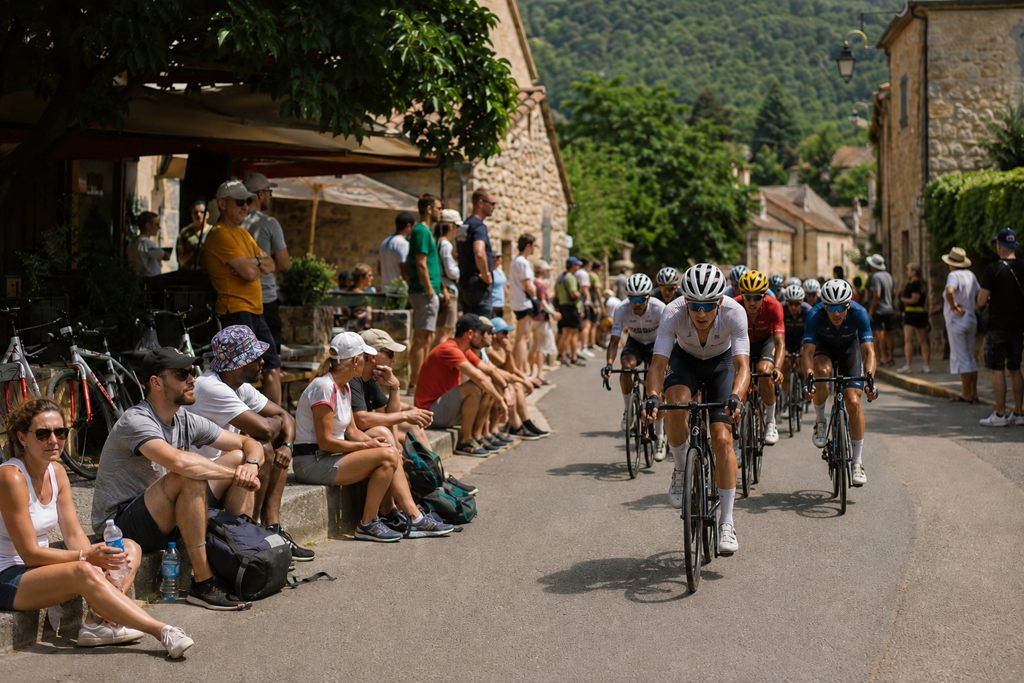
For many spectators, the Tour de France is not like attending a stadium event. You are often standing on a roadside, moving between towns, waiting near a climb, or spending time in a village that has adjusted itself around race day.
That can feel exciting, but also a little disorienting.
Roads may close earlier than expected. Restaurants may be busier than usual. Local transport may run differently. Lodging near the route may be limited or expensive. And once you choose a stage, you are also choosing the surrounding region: its pace, terrain, food, weather, and travel rhythm.
This is why the host region deserves attention before the trip. A mountain stage in the Alps or Pyrenees feels very different from a flatter transition stage through towns and countryside. A finish town feels different from a roadside viewing spot. A start town gives you a different kind of access than a high mountain climb.
The race may be the headline, but the region shapes the day.
Choose Your Base For The Region, Not Just The Race Map
A common mistake is choosing lodging based only on how close it looks to the route. On a normal travel day, that might work. During the Tour, it can be misleading.
A town that looks close on the map may be difficult to reach once road closures begin. A hotel near the route may be convenient the night before but awkward the morning after. A small village may be beautiful but limited if you need meals, parking, train access, or flexibility.
A better approach is to choose a base that gives you a stable travel rhythm.
That could mean staying in a larger nearby town with train service, restaurants, and multiple road options. It could mean staying slightly farther away from the race route in exchange for easier movement. Or it could mean accepting that you will stay put for the day and enjoy the race from one carefully chosen location.
For Tour de France spectators, convenience is not always about being closest. It is often about being least trapped.
Let The Region Slow The Trip Down
One of the easiest ways to enjoy the French host region is to avoid packing too much into race day.
It is tempting to imagine watching the caravan, seeing the riders pass, visiting multiple towns, eating a long lunch, and squeezing in sightseeing before sunset. Sometimes that works. Often, it creates unnecessary stress.
The Tour has its own pace. The publicity caravan, crowd buildup, road closures, waiting time, and race passage all stretch the day. The riders may pass quickly, but the event surrounding them does not feel quick.
That is not a problem if you expect it.
Plan the day around waiting well. Pick a viewing area where you would not mind spending several hours. Bring water, sun protection, layers, snacks, and patience. Notice the village, the landscape, the local fans, and the small rituals around the race.
The region becomes more enjoyable when you stop treating the wait as wasted time.
Mountain Stages And Town Stages Ask For Different Mindsets
Not every Tour de France host region experience works the same way.
Mountain stages often feel dramatic, scenic, and physically demanding for spectators. You may deal with long walks, limited parking, changing weather, steep roads, and fewer services once you are in place. The reward is atmosphere: fans settled along climbs, flags, camper vans, cowbells, and a sense that the landscape itself is part of the race.
Town stages can feel more accessible, especially around starts and finishes. You may have more restaurants, hotels, public transport, and crowd control infrastructure. But they can also be more congested, more commercial, and harder to move through quickly.
Rural roadside viewing can feel peaceful and authentic, but it requires more self-sufficiency. You may not have easy access to bathrooms, shade, food, or transport once roads close.
None of these options is automatically better. The right choice depends on the kind of day you want: scenic and patient, urban and energetic, simple and local, or logistically easier.
The Race Passes Quickly, So Build A Day Around More Than The Moment
For first-time spectators, one surprise is how brief the actual race moment can feel. You may wait for hours, hear helicopters, see the caravan, feel the crowd shift, and then the riders pass in a rush.
That does not make the experience disappointing. It just means the trip should not depend entirely on the seconds when the peloton is in front of you.
The fuller experience includes the morning walk through town, the bakery line with other fans, the local families setting up chairs, the quiet roads before the race arrives, the changing energy as police vehicles pass, and the shared reaction after the riders are gone.
This is where the French host region matters most. The day becomes less about “how long did I see the riders?” and more about “what did it feel like to be there?”
That is a healthier expectation for spectator sports tourism.
Do Not Treat Every Host Town Like A Major Tourist City
Some Tour de France host towns are well equipped for visitors. Others are smaller places temporarily carrying the weight of an international sporting event.
That difference matters.
A smaller host town may have limited hotel capacity, earlier restaurant bookings, fewer taxis, and less English-language support than a major city. That does not make it a bad choice. In fact, smaller towns can offer some of the most memorable Tour experiences. But they reward travelers who plan gently and realistically.
Book lodging early when possible. Avoid assuming that rideshares or taxis will be easy to find. Check local train and bus options before committing. Make meal plans flexible. Carry cash as a backup. Build in time for walking.
The goal is not to over-plan every minute. It is to avoid putting too much pressure on a small place during a very busy day.
Give Yourself A Non-Race Reason To Be There
A helpful way to choose and enjoy a host region is to ask: “Would I still enjoy this place if the race day becomes complicated?”
That question is grounding.
Weather may change. Roads may close earlier than you expected. Your preferred viewing spot may be too crowded. The race schedule may shift. Even in recent editions, stages have had to be adjusted because of local conditions; in 2025, stage 19 was shortened after a cattle disease outbreak affected part of the planned route.
When you have a non-race reason to enjoy the region, the trip becomes more resilient.
That reason might be food, scenery, wine country, mountain villages, cycling history, architecture, local markets, or simply a slower few days in France. You do not need to turn the trip into a full destination guide. You just need one or two regional anchors beyond the race itself.
A simple regional plan can make the whole experience feel less fragile.
Avoid Chasing Too Much Of The Tour
Some travelers imagine following several stages in a row. That can be rewarding, but it is more demanding than it sounds.
The Tour de France covers long distances over many stages, and the modern race traditionally runs across 21 day-long stages over more than three weeks. Following even a small part of it can mean repeated packing, early departures, road restrictions, unfamiliar towns, and constant timing decisions.
For many spectators, one well-planned stage plus a few calm regional days is better than three rushed race days.
That does not mean you should never follow the race. It just means the trip should match your tolerance for logistics. If you enjoy complex travel planning, moving between stages can be part of the fun. If you want a calmer sports tourism experience, choose one stage, settle into the region, and let the race be the centerpiece rather than the whole itinerary.
The Best Tour de France Trip Feels Local, Not Perfect
A good Tour de France spectator trip does not need to be perfectly optimized.
You do not need the most famous climb, the most dramatic helicopter-view scenery, or the exact spot seen on television. You need a realistic place to watch, a manageable way to get there, and enough space in the itinerary to enjoy the region around the event.
The French host region is not just scenery passing behind the riders. It is where you eat, walk, wait, navigate, rest, and remember the trip. When you respect that, the experience becomes less frantic and more satisfying.
The clearest approach is simple: pick a stage that fits your travel style, choose a base that supports the whole visit, expect race day to move slowly until it suddenly moves fast, and give yourself something meaningful to enjoy beyond the peloton.
That is how the Tour de France becomes more than a sporting event you watched for a few seconds. It becomes a grounded sports tourism experience in a real French place.
Download Our Free E-book!