Working from home without feeling like you’re always working usually comes down to one quiet skill: creating clearer edges around your day.
The problem is not always that you are working too much. Sometimes the problem is that work has lost its natural boundaries. There is no commute to signal the beginning or end of the day. There is no office door to walk out of. There is no physical separation between “I am working” and “I am home.”
So the workday starts to blur.
You check one email after dinner. You reopen your laptop because a small task is still on your mind. You walk past your desk and remember something unfinished. Even when you are technically off, part of you still feels available.
That is why working from home can feel both flexible and draining at the same time.
The Real Issue Is Not Always Time
Many people assume the solution is better time management. Sometimes that helps, but the deeper issue is often attention.
When your work tools are always nearby, your mind keeps receiving small reminders that work is still accessible. A laptop on the kitchen table, notifications on your phone, a notebook left open beside the couch, or a desk in the corner of the bedroom can all quietly suggest that the workday is not fully over.
This does not mean you need a perfect home office or a rigid schedule. It means your brain needs clearer cues.
Working from home feels easier when your day has recognizable signals. A simple start ritual, a clear stopping point, and a small transition back into home life can make a real difference.
Flexibility Can Turn Into Constant Availability
One of the best parts of working from home is flexibility. You may be able to start earlier, take breaks when needed, handle personal tasks during the day, or design your environment in a way that supports you.
But flexibility can become confusing when every hour feels like a possible work hour.
If you answer messages at night, work through breaks, or keep checking tasks “just in case,” your mind may stop trusting that rest is real. Even if you are not working every minute, you may still feel mentally attached to work.
That is the exhausting part.
It is not only the hours you spend working. It is the feeling that work can interrupt any part of the day.
A Workday Needs an Ending You Can Feel
In a traditional workplace, the end of the day is usually physical. You pack up. You leave the building. You drive home, walk home, or take transit. Even if the job was stressful, there is some kind of shift.
At home, you may need to create that shift on purpose.
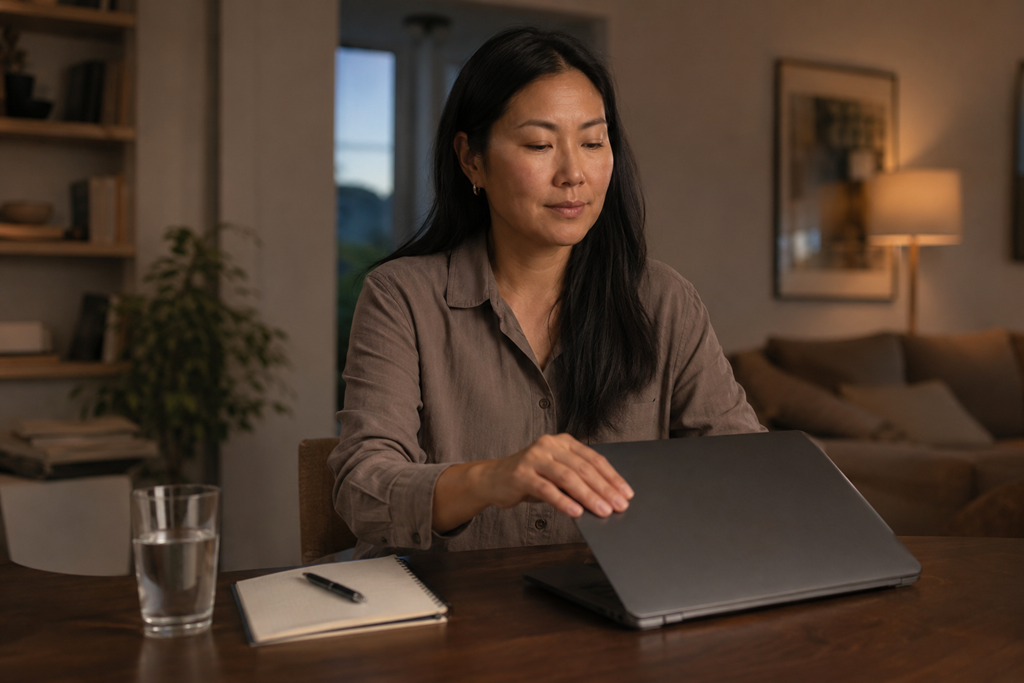
This does not have to be dramatic. It might be closing your laptop, clearing your desk, writing down the first task for tomorrow, turning off work notifications, changing clothes, taking a short walk, or moving into another room for a few minutes.
The point is not the specific action. The point is that your body and mind receive a clear message: work is done for now.
Without that message, the day can feel unfinished even when you have done enough.
Your Workspace Does Not Have To Be Perfect
A common misunderstanding is that working from home only feels balanced if you have a separate office. A dedicated room can help, but many people do not have that option.
You can still create boundaries with smaller signals.
A specific chair, a particular corner of the table, a tray for work items, a lamp you turn on only during work hours, or a habit of putting your laptop away at the end of the day can all help. These small cues teach your brain when you are in work mode and when you are not.
The goal is not to make your home look like an office. The goal is to prevent your entire home from feeling like one.
Breaks Should Not Feel Like Escaping
When work has no clear boundaries, breaks can start to feel guilty. You step away, but part of you feels like you are doing something wrong.
That feeling is a sign that the workday needs more structure, not more pressure.
A real break is not a reward for being perfectly productive. It is part of staying steady. If you work from home, breaks help replace the natural pauses that often happen in outside workplaces, such as walking to a meeting, talking briefly with a coworker, or stepping out for lunch.
At home, those pauses may disappear unless you protect them.
Even short breaks can help your day feel less compressed. The important part is allowing the break to be a break, not a half-break filled with checking messages.
The Small “One More Thing” Habit Adds Up
One pattern that makes remote work feel endless is the habit of doing “one more thing.”
One more email. One more edit. One more reply. One more quick check.
Individually, these tasks seem harmless. But over time, they teach your mind that the workday never really closes. This can make evenings feel lighter on paper but heavier emotionally.
A better approach is to have a place to park unfinished work. Writing down what needs attention tomorrow can reduce the urge to keep reopening tasks at night.
You are not ignoring your responsibilities. You are giving them a place to wait.
Home Life Needs Its Own Space Too
When people talk about working from home, they often focus on protecting work time from home distractions. That matters, but the reverse matters too.
Home time needs protection from work.
If work is allowed to occupy every quiet space, your home may stop feeling restorative. You may still live there, eat there, and sleep there, but mentally it can begin to feel like an extension of the job.
This is why small boundaries matter. They help your home remain a place where you can recover, connect, think, and simply exist without always being useful.
For many people, that is the real challenge of remote work: not productivity, but permission to stop.
Feeling “Always On” Does Not Mean You Are Doing It Wrong
If working from home makes you feel like you are always working, it does not mean you lack discipline. It may mean your environment, tools, and habits are not giving you enough separation.
Remote work asks your home to hold more roles than it used to. It may now be your office, meeting room, planning space, rest space, dining space, and personal space all at once. That overlap can be useful, but it can also create mental clutter.
The answer is not to reject flexibility. It is to make flexibility more defined.
You can still enjoy the benefits of working from home while giving your day a beginning, middle, and end.
A Way To Think About Working From Home
Working from home works best when it feels like a rhythm, not a constant open loop.
You need enough structure to know when you are working. You need enough space to know when you are done. And you need enough self-trust to believe that stopping is allowed.
The goal is not to create a perfect routine or separate every part of your life completely. The goal is to make work feel contained enough that the rest of your life can breathe.
When your workday has clearer edges, home can start to feel like home again.
Download Our Free E-book!