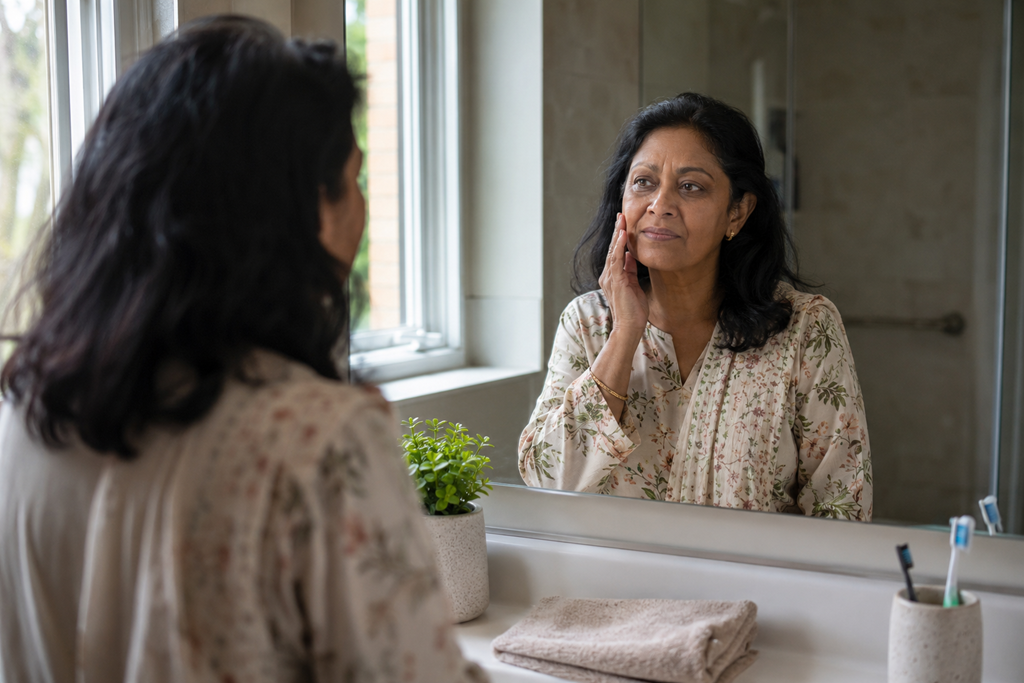
Approaching aging without fear or resistance starts with changing what aging means in your mind. Instead of seeing it only as decline, loss, or proof that life is narrowing, it helps to see aging as a normal life transition that asks for more honesty, adjustment, and care.
That does not mean pretending every change feels easy. It also does not mean forcing yourself to “stay young” at all costs. A healthier approach is to notice what is changing, accept what deserves attention, and keep participating in life in ways that still feel meaningful.
For many people, fear around aging is not really about age itself. It is about what they imagine age will take away: independence, energy, attractiveness, confidence, relevance, mobility, or choice. When those fears stay unspoken, aging can start to feel like something to fight against instead of something to understand.
Aging Can Feel Personal Before It Feels Practical
Aging often becomes emotional in small, ordinary moments.
You may notice it when your body takes longer to recover, when your face looks different in a photo, when a familiar activity feels harder, or when younger people seem to move through life with a kind of ease you remember having. These moments can bring up frustration, sadness, comparison, or even embarrassment.
That reaction is understandable. Aging is not just a physical process. It can affect how you see yourself.
You may still feel young internally while your body, schedule, energy, or priorities begin to change. That gap between how you feel inside and what you notice outside can be unsettling. It can make aging feel like something happening to you rather than something you are allowed to take part in thoughtfully.
Resistance Often Comes From Trying To Protect Your Old Identity
Many people resist aging because they are trying to hold onto a version of themselves that once felt reliable.
Maybe you were once the person who could work long hours without much recovery. Maybe you were active without thinking much about stretching, sleep, or joint care. Maybe you were used to looking a certain way, being depended on in a certain way, or feeling physically capable without planning around your limits.
When those patterns change, it can feel like your identity is being challenged.
But aging does not erase who you are. It asks you to update how you care for yourself. That difference matters.
You are not failing because your body has different needs. You are not less valuable because your pace has changed. You are not behind because you need more rest, more support, or more intention than you once did.
Accepting Aging Is Not The Same As Giving Up
One of the biggest misunderstandings about aging is the belief that acceptance means surrender.
It does not.
Accepting aging means telling the truth about where you are now so you can make better choices. It means paying attention before small issues become bigger ones. It means choosing habits, routines, relationships, and environments that support the life you want to keep living.
Giving up sounds like, “There is no point anymore.”
Acceptance sounds like, “This part of my life needs a different approach now.”
That difference can change everything.
When you accept that your body and life stage are changing, you can respond with more wisdom. You can move in ways that protect your joints. You can build strength without chasing old standards. You can make your home easier to live in. You can value rest without treating it as laziness. You can ask for help without making it mean you are weak.
Fear Grows When Aging Is Treated Like A Problem To Hide
A lot of fear around aging comes from the pressure to disguise it.
People are often encouraged to look younger, act younger, move younger, dress younger, and compare themselves to younger versions of themselves. Over time, that can create the feeling that natural change is something shameful.
But hiding from aging usually makes it more stressful.
When every visible sign of age feels like a threat, daily life becomes harder than it needs to be. A wrinkle becomes evidence. A slower morning becomes failure. A new limitation becomes a warning sign that everything is slipping away.
A more helpful view is to separate normal change from true neglect.
Normal change means your body and life are evolving. True neglect means ignoring what needs care. The goal is not to deny aging. The goal is to stay involved in your well-being as your needs change.
Your Pace May Change Without Your Life Becoming Smaller
Aging can bring a different pace, but a different pace does not have to mean a smaller life.
You may travel differently. Exercise differently. Socialize differently. Work differently. Rest differently. Plan differently. Some things may require more thought than they used to.
That can feel frustrating at first, especially if you are used to measuring your life by speed, productivity, appearance, or endurance.
But a meaningful life is not only measured by how much you can push through.
It can also be measured by how well you know yourself, how wisely you use your energy, how present you are with people you care about, and how honestly you choose what deserves your attention.
Aging may invite you to stop proving certain things. It may also invite you to protect what matters more carefully.
Comparison Can Make Aging Feel More Threatening Than It Is
Fear of aging often gets worse when you compare yourself too often.
You may compare yourself to younger people, healthier people, people with more energy, people who seem to age effortlessly, or your own past self. Some comparison is natural, but too much of it can distort how you see your life.
Your body has its own history. Your responsibilities, health background, stress level, finances, family demands, and environment all shape how aging feels for you.
That is why comparing your aging process to someone else’s can be unfair.
Aging well does not mean matching another person’s timeline. It means paying attention to your own life with enough honesty to make choices that support it.
A Healthier Relationship With Aging Starts With Respect
Aging becomes less frightening when you stop treating your body like an enemy.
Your body is not betraying you simply because it changes. In many cases, it is giving you information. It may be asking for more sleep, more movement, better nourishment, less strain, different routines, or more medical attention.
Respecting your body does not mean liking every change. It means listening before resentment takes over.
You can be disappointed by a change and still respond with care. You can miss what used to be easy and still build new ways to stay active. You can want to look and feel good without turning aging into a battle.
That kind of respect makes room for both honesty and hope.
You Do Not Have To Feel Positive About Every Part Of Aging
Some advice about aging can feel unrealistic because it pressures people to be cheerful about every change.
You do not have to love every part of aging to approach it in a healthier way.
You can grieve certain changes. You can feel uncertain. You can need time to adjust. You can have days when your reflection, energy level, or physical limitations feel difficult. Those reactions do not mean you are doing aging wrong.
What matters is whether fear becomes the main voice guiding your decisions.
Fear may tell you to avoid the doctor, stop trying new things, hide from people, overdo exercise to prove a point, or give up before you know what is still possible. A more useful response is to let discomfort be acknowledged without letting it make every decision.
Aging With Less Resistance Means Staying In Conversation With Your Life
Aging is not one single moment you accept once and never think about again. It is an ongoing conversation with your body, your priorities, your relationships, and your expectations.
Some seasons will require adjustment. Some changes will be easier to accept than others. Some limits may be temporary, while others may ask for a new way of living.
The goal is not to control every part of aging. The goal is to stay engaged instead of shutting down.
That may look like making your routines more supportive, choosing movement that fits your current body, having honest conversations, simplifying what drains you, or paying attention to the parts of life that still bring connection and purpose.
Aging without fear or resistance does not mean aging without emotion. It means you stop treating every change as a threat. You give yourself permission to adapt, care for yourself, and continue building a life that feels worth participating in.
Download Our Free E-book!