Venice is one of those cities where the best experiences often happen between the famous sights: crossing a small bridge, turning into a quiet lane, watching boats move along the Grand Canal, or stepping into a neighborhood that feels far removed from the busiest squares.
This 2-day Venice itinerary is designed for first-time visitors who want to see the essentials without packing every hour too tightly. You’ll visit major landmarks like St. Mark’s Square, the Doge’s Palace, the Rialto Bridge, and the Grand Canal, while still leaving room for quieter walks, local neighborhoods, and a lagoon island visit.
Because Venice is compact but crowded in places, this itinerary focuses on logical walking routes, realistic pacing, and classic experiences that are likely to remain worthwhile over time.
Before You Start: How To Approach 2 Days In Venice
Two days is enough time to get a strong feel for Venice, especially if you stay in or near the historic center. You will not see everything, but you can experience the city’s main landmarks, canals, neighborhoods, and lagoon atmosphere without rushing from one attraction to the next.
Venice is best explored mostly on foot. Public water transport, including vaporetti, connects key stops around the city and lagoon, and Venezia Unica describes the city’s transport options as including vaporetti, buses, trams, People Mover, ferry boats, and airport water connections.
A few practical notes before planning your days:
- Wear comfortable walking shoes. Venice involves bridges, stone paths, and uneven surfaces.
- Book major sights ahead during busy travel periods.
- Check current opening hours before visiting churches, museums, or palaces.
- Build in extra time for getting pleasantly turned around.
- Avoid trying to see every island, museum, and viewpoint in one short visit.
Day 1: Classic Venice, St. Mark’s Square, And The Grand Canal
Your first day focuses on Venice’s most iconic area: San Marco, the waterfront, the Doge’s Palace, the Basilica, the Rialto area, and the Grand Canal.
Morning: Start Early In St. Mark’s Square
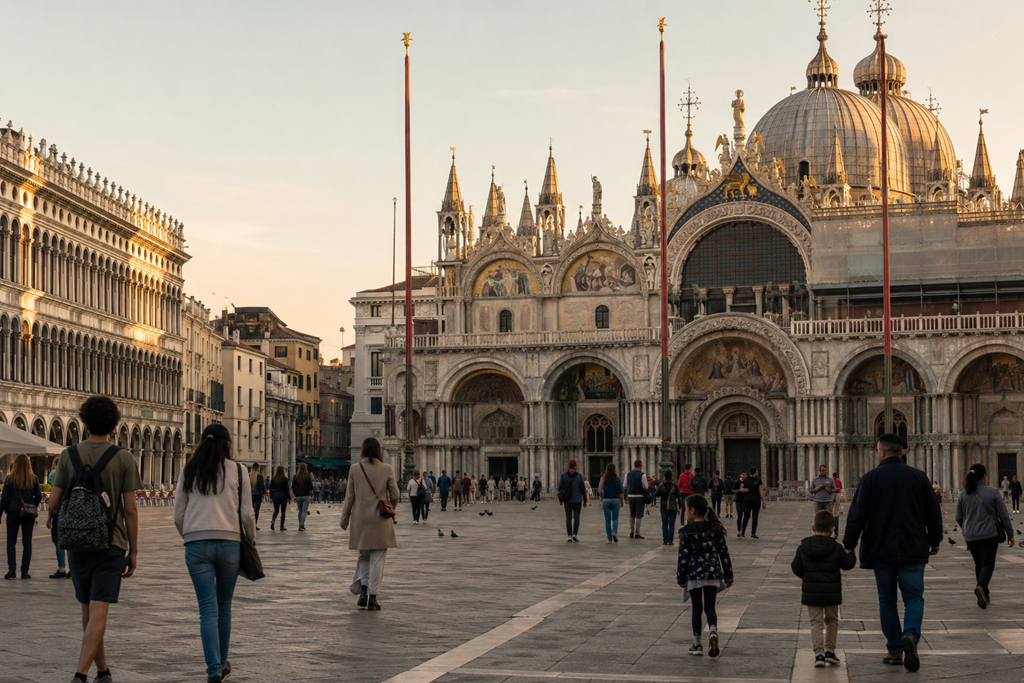
Begin your day in Piazza San Marco, the city’s most famous square. This is the Venice many travelers imagine before they arrive: grand architecture, open space, arcades, domes, and the sound of footsteps echoing across stone.
Venezia Unica describes San Marco as Venice’s best-known sestiere and notes that St. Mark’s Square is home to major monuments including the Basilica, St. Mark’s Bell Tower, the Doge’s Palace, the Clock Tower, and the Correr Museum.
Arriving early gives you the best chance to enjoy the square before the busiest part of the day. Even if you do not enter every attraction, take time to look around slowly. Notice the details on the Basilica façade, the long arcades around the square, and the way the space opens toward the lagoon.
Visit St. Mark’s Basilica
Next, visit St. Mark’s Basilica, one of Venice’s defining landmarks. Venezia Unica notes that the Basilica was begun in 828 to house the relics of St. Mark and is often called the “Golden Church” because of the richness of its history and decoration.
Inside, the mosaics, marble floors, and Byzantine-influenced design make it one of the most memorable religious sites in Italy. Since entry rules and access areas can change, check current visitor details before you go.
If you enjoy architecture, religious history, or decorative art, give yourself enough time here. If your trip is more focused on walking and atmosphere, even a shorter visit can be worthwhile.
Tour The Doge’s Palace
After the Basilica, visit the Doge’s Palace, located beside St. Mark’s Square and facing the lagoon. This was the political heart of the Venetian Republic and remains one of the city’s most important historic buildings.
The palace is especially worthwhile because it combines architecture, art, political history, and dramatic interior spaces. Many visits also include the Bridge of Sighs route, which connects the palace to the former prison area.
This is one of the attractions where booking ahead can help, especially during popular travel periods. Do not try to rush it in 30 minutes. For most visitors, it deserves a meaningful part of the morning or early afternoon.
Midday: Walk The Waterfront Toward The Bridge Of Sighs
After visiting the palace, step outside toward the lagoon-facing promenade near the Riva degli Schiavoni. This area gives you classic views of gondolas, moored boats, church domes, and the water beyond the main island.
Stop near the exterior view of the Bridge of Sighs, one of Venice’s most photographed spots. It can be busy, but it is still worth seeing because it connects directly to the history of the Doge’s Palace and the old prison route.
From here, you can pause for lunch nearby or walk a little away from the most crowded streets before choosing a place to eat. In Venice, even a few turns away from a major landmark can make a noticeable difference in atmosphere.
Afternoon: Wander From San Marco To Rialto
After lunch, walk gradually from San Marco toward the Rialto Bridge. This route is busy, but it is also part of the classic Venice experience.
Rather than treating the Rialto Bridge as only a photo stop, spend time on both sides of the Grand Canal. The bridge itself offers one of the city’s most recognizable views, with boats moving below and historic buildings lining the water.
Nearby, the Rialto market area gives you a different side of Venice. The market has long been associated with food, trade, and daily life. Visit earlier in the day if the market itself is a priority, but even later, the surrounding streets are worth exploring.
Take A Grand Canal Vaporetto Ride
Late afternoon is a good time to experience the Grand Canal from the water. Instead of thinking of the vaporetto only as transportation, treat it as a moving sightseeing route.
A ride along the Grand Canal lets you see palaces, water entrances, bridges, and everyday boat traffic from the perspective that makes Venice unique. ACTV provides waterborne public transport in Venice, and its route map includes major stops such as Piazzale Roma, Ferrovia, Rialto, San Marco, Lido, Murano, and Burano.
This can be one of the best-value experiences in Venice because it gives you the feeling of the city from the water without needing a private boat ride.
Evening: Return To A Quieter Neighborhood For Dinner
For your first evening, consider eating away from the busiest part of San Marco. Venice is more enjoyable when you allow some space between major sightseeing and dinner.
Good areas to consider include:
- Cannaregio, for a more lived-in neighborhood feel
- Dorsoduro, for quieter canals and evening walks
- San Polo, if you want to stay near Rialto but slightly away from the densest crowds
Keep dinner simple and regional. Look for Venetian dishes such as seafood, risotto, polenta, cicchetti, or seasonal vegetables. Rather than chasing a “must-visit” restaurant, choose a place that fits your location, budget, and energy level.
After dinner, take a slow walk. Venice changes beautifully at night, especially once day-trippers have left and the smaller canals become quieter.
Day 2: Dorsoduro, Cannaregio, And The Lagoon Islands
Your second day balances art, local neighborhoods, and the wider lagoon. You can either spend the afternoon visiting Murano and Burano or keep the entire day inside Venice if you prefer a slower pace.
Morning: Explore Dorsoduro
Start your second day in Dorsoduro, one of Venice’s most rewarding neighborhoods for walking. It has canals, museums, churches, cafés, and a slightly more relaxed feel than the busiest parts of San Marco.
A good route is to begin near the Accademia Bridge, where you can enjoy one of the classic Grand Canal views. From there, walk toward the Gallerie dell’Accademia if you are interested in Venetian painting, or continue toward the Peggy Guggenheim Collection if you prefer modern art.
You do not need to visit both museums in a short 2-day itinerary. Choose one based on your interests, or skip museum time altogether and focus on walking.
Walk To Punta Della Dogana And Santa Maria Della Salute
From central Dorsoduro, continue toward Punta della Dogana, the triangular point where the Grand Canal meets the Giudecca Canal. This area gives you wide water views and a beautiful perspective back toward San Marco.
Nearby, visit or admire Santa Maria della Salute, one of Venice’s most recognizable churches. Even if you only see it from the outside, the setting is memorable.
This part of Venice works especially well in the morning because it combines open views, architecture, and a natural walking route without requiring a complicated plan.
Midday: Try Cicchetti For Lunch
For lunch, consider trying cicchetti, Venice’s small bites often served with a drink in informal bars known as bacari. This is one of the easiest food experiences to fit into a short visit because it can be casual, flexible, and more relaxed than a long sit-down meal.
You might choose a few small plates and continue walking, or make it a slower lunch if you find a comfortable spot. As always in Venice, avoid judging only by location. A quieter side street can be a better choice than the most visible place beside a major landmark.
Afternoon Option 1: Visit Murano And Burano
If you want to see the lagoon beyond central Venice, spend your afternoon visiting Murano and Burano.
Murano is known for glassmaking, while Burano is known for colorful houses and lace traditions. The official Burano guide highlights the island’s painted houses, lace tradition, and boat connections as key parts of planning a visit.
This option works best if you start soon after lunch and accept that you may only get a short taste of each island. Murano is usually easier to combine with Venice because it is closer. Burano takes more time but offers a very different visual experience.
A simple approach:
- Go to Murano first for glassmaking history and a short walk.
- Continue to Burano for colorful streets, canals, and a slower wander.
- Return to Venice before evening, allowing extra time for boat connections.
Do not overload this afternoon with Torcello unless you are especially interested in older lagoon history and are comfortable with a longer day.
Afternoon Option 2: Stay In Venice And Explore Cannaregio
If you prefer not to spend time on boats, use the afternoon to explore Cannaregio instead. This is one of the best areas for a more grounded sense of Venice beyond the postcard views.
Walk along quieter canals, visit the area around the historic Jewish Ghetto, and give yourself time to drift through residential lanes. Cannaregio is especially good for travelers who enjoy observing daily life, photography, and less crowded streets.
This is also a good choice if the weather is uncertain, if you are traveling with someone who gets tired easily, or if you would rather not spend part of your final day managing island transport.
Late Afternoon: See Venice From A Different Angle
Before dinner, choose one final scenic experience:
- Cross the Accademia Bridge for Grand Canal views.
- Take another short vaporetto ride at golden hour.
- Walk along the waterfront near San Marco.
- Visit a bell tower or viewpoint if current access works with your schedule.
- Sit by a quiet canal and let the city slow down around you.
Venice rewards travelers who leave space for unplanned moments. In a city this layered, a quiet 20-minute pause can be just as memorable as a formal attraction.
Evening: End With A Slow Walk And A Simple Dinner
For your final evening, choose dinner in a neighborhood where you already plan to be. Dorsoduro, Cannaregio, and San Polo are all good options depending on your route.
After dinner, take one last walk without trying to accomplish anything. Venice is especially atmospheric after dark, when the lights reflect on the canals and the smaller streets feel more intimate.
This is a good time to revisit a favorite bridge, walk along the Grand Canal, or return to St. Mark’s Square when it is less crowded.
Where To Stay For A 2-Day Venice Itinerary
For only two days, location matters. Staying in or near the historic center helps you spend less time commuting and more time experiencing the city.
Good areas for first-time visitors include:
San Marco
Best if you want to be close to major landmarks. It is convenient but often more crowded and expensive.
San Polo
Best if you want central access near Rialto with a slightly more practical feel.
Dorsoduro
Best if you want beauty, museums, canals, and a somewhat quieter base.
Cannaregio
Best if you want a more local-feeling stay while still being connected to the rest of Venice.
Near Santa Lucia Station
Best if you are arriving or leaving by train and want convenience with luggage.
For a short stay, avoid choosing a place too far from your main interests unless you are comfortable navigating boats and walking with bags.
What To Prioritize If You Have Limited Time
If your schedule gets shortened or you prefer a slower pace, prioritize:
- St. Mark’s Square
- St. Mark’s Basilica
- Doge’s Palace
- Rialto Bridge
- A Grand Canal vaporetto ride
- One quieter neighborhood, such as Dorsoduro or Cannaregio
If you have extra energy, add Murano and Burano. If not, stay in Venice and enjoy the neighborhoods more deeply.
Practical Venice Travel Tips
Book Key Attractions Ahead During Busy Periods
For major sights like the Doge’s Palace and St. Mark’s Basilica, advance planning can reduce stress. Timed-entry rules and ticketing systems may change, so check current details before your visit.
Leave More Time Than The Map Suggests
Venice is walkable, but routes are rarely as direct as they look. Bridges, crowds, narrow lanes, and photo stops all add time.
Use Vaporetti Strategically
You do not need to use water transport constantly, but it helps for longer distances, island visits, luggage days, and Grand Canal views. ACTV operates Venice’s water and land transport services, including water buses in the historic center and surrounding areas.
Be Respectful Of Local Life
Venice is not just a visitor destination. It is also a fragile historic city where people live and work. Keep noise down in residential areas, avoid blocking narrow bridges, and follow posted guidance around monuments and churches.
Pack Light If Possible
Luggage can be difficult in Venice because of bridges, stone streets, and limited vehicle access in the historic center. A smaller bag makes arrival and departure much easier.
A Flexible 2-Day Venice Itinerary At A Glance
Day 1
Morning: St. Mark’s Square, St. Mark’s Basilica, Doge’s Palace
Midday: Waterfront walk and Bridge of Sighs
Afternoon: Walk toward Rialto, explore the Grand Canal area
Late Afternoon: Vaporetto ride on the Grand Canal
Evening: Dinner in Cannaregio, Dorsoduro, or San Polo
Day 2
Morning: Dorsoduro, Accademia Bridge, museum or scenic walk
Midday: Cicchetti lunch
Afternoon: Murano and Burano, or Cannaregio if staying in Venice
Late Afternoon: Scenic viewpoint, canal walk, or vaporetto ride
Evening: Final dinner and slow walk through Venice
The Best Way To Experience Venice In 2 Days
The best 2-day Venice itinerary is not the one with the most stops. It is the one that gives you enough structure to see the essentials and enough space to feel the city.
Use your first day for classic Venice: San Marco, the Doge’s Palace, Rialto, and the Grand Canal. Use your second day for Dorsoduro, quieter neighborhoods, and possibly the lagoon islands. Walk often, pause when something catches your attention, and let Venice be more than a checklist.
With a thoughtful route and realistic expectations, two days in Venice can feel rich, memorable, and surprisingly complete.
Download Our Free E-book!